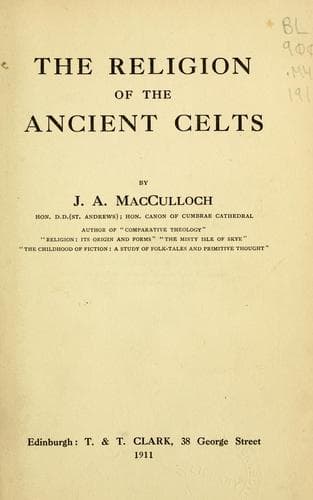
The Religion of the Ancient CeltsMacCulloch, J. A. (John Arnott)
Religion
The Religion of the Ancient Celts
MacCulloch, J. A. (John Arnott)
Celts -- Religion; Mythology, Celtic
But why were the Tuatha Dé Danann associated with the mounds? If fairies
or an analogous race of beings were already in pagan times connected
with hills or mounds, gods now regarded as fairies would be connected
with them. Dr. Joyce and O'Curry think that an older race of aboriginal
gods or _síd-folk_ preceded the Tuatha Déa in the mounds.[208] These may
have been the Fomorians, the "champions of the _síd_," while in _Mesca
Ulad_ the Tuatha Déa go to the underground dwellings and speak with the
_síde_ already there. We do not know that the fairy creed as such
existed in pagan times, but if the _síde_ and the Tuatha Dé Danann were
once distinct, they were gradually assimilated. Thus the Dagda is called
"king of the _síde_"; Aed Abrat and his daughters, Fand and Liban, and
Labraid, Liban's husband, are called _síde_, and Manannan is Fand's
consort.[209] Labraid's island, like the _síd_ of Mider and the land to
which women of the _síde_ invite Connla, differs but little from the
usual divine Elysium, while Mider, one of the _síde_, is associated with
the Tuatha Dé Danann.[210] The _síde_ are once said to be female, and
are frequently supernatural women who run away or marry mortals.[211]
Thus they may be a reminiscence of old Earth goddesses. But they are not
exclusively female, since there are kings of the _síde_, and as the name
_Fir síde_, "men of the _síde_," shows, while S. Patrick and his friends
were taken for _síd_-folk.
The formation of the legend was also aided by the old cult of the gods
on heights, some of them sepulchral mounds, and now occasionally sites
of Christian churches.[212] The Irish god Cenn Cruaich and his Welsh
equivalent Penn Cruc, whose name survives in _Pennocrucium_, have names
meaning "chief _or_ head of the mound."[213] Other mounds or hills had
also a sacred character. Hence gods worshipped at mounds, dwelling or
revealing themselves there, still lingered in the haunted spots; they
became fairies, or were associated with the dead buried in the mounds,
as fairies also have been, or were themselves thought to have died and
been buried there. The haunting of the mounds by the old gods is seen in
a prayer of S. Columba's, who begs God to dispel "this host (i.e. the
old gods) around the cairns that reigneth."[214] An early MS also tells
how the Milesians allotted the underground part of Erin to the Tuatha
Déa who now retired within the hills; in other words, they were gods of
the hills worshipped by the Milesians on hills.[215] But, as we shall
see, the gods dwelt elsewhere than in hills.[216]
Public-domain text, read in full here on John Shaqi.
Reviews
Reviews
No reviews yet
Be the first to share your thoughts on this work.
Elsewhere in the archive
Join the Discussion
Join the discussion
Sign in to leave a comment or review.
Sign InorCreate an account