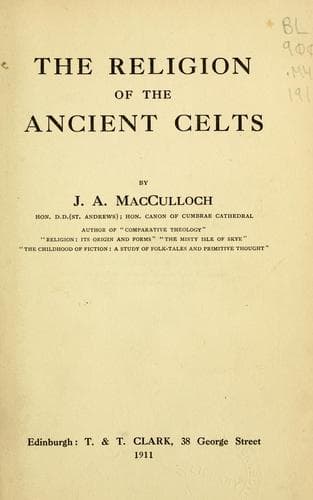
The Religion of the Ancient CeltsMacCulloch, J. A. (John Arnott)
Religion
The Religion of the Ancient Celts
MacCulloch, J. A. (John Arnott)
Celts -- Religion; Mythology, Celtic
Tumuli may already in pagan times have been pointed out as tombs of gods
who died in myth or ritual, like the tombs of Zeus in Crete and of
Osiris in Egypt. Again, fairies, in some aspects, are ghosts of the
dead, and haunt tumuli; hence, when gods became fairies they would do
the same. And once they were thought of as dead kings, any notable
tumuli would be pointed out as theirs, since it is a law in folk-belief
to associate tumuli or other structures not with the dead or with their
builders, but with supernatural or mythical or even historical
personages. If _síde_ ever meant "ghosts," it would be easy to call the
dead gods by this name, and to connect them with the places of the
dead.[217]
Many strands went to the weaving of the later conception of the gods,
but there still hung around them an air of mystery, and the belief that
they were a race of men was never consistent with itself.
Danu gave her name to the whole group of gods, and is called their
mother, like the Egyptian Neith or the Semitic Ishtar.[218] In the
annalists she is daughter of Dagda, and has three sons. She may be akin
to the goddess Anu, whom Cormac describes as "_mater deorum
hibernensium_. It was well she nursed the gods." From her name he
derives _ana_, "plenty," and two hills in Kerry are called "the Paps of
Anu."[219] Thus as a goddess of plenty Danu or Anu may have been an
early Earth-mother, and what may be a dim memory of Anu in
Leicestershire confirms this view. A cave on the Dane Hills is called
"Black Annis' Bower," and she is said to have been a savage woman who
devoured human victims.[220] Earth-goddesses usually have human victims,
and Anu would be no exception. In the cult of Earth divinities Earth and
under-Earth are practically identical, while Earth-goddesses like
Demeter and Persephone were associated with the underworld, the dead
being Demeter's folk. The fruits of the earth with their roots below the
surface are then gifts of the earth- or under-earth goddess. This may
have been the case with Danu, for in Celtic belief the gifts of
civilisation came from the underworld or from the gods. Professor
Rh[^y]s finds the name Anu in the dat. _Anoniredi_, "chariot of Anu," in
an inscription from Vaucluse, and the identification is perhaps
established by the fact that goddesses of fertility were drawn through
the fields in a vehicle.[221] Cormac also mentions Buanann as mother and
nurse of heroes, perhaps a goddess worshipped by heroes.[222]
Public-domain text, read in full here on John Shaqi.
Reviews
Reviews
No reviews yet
Be the first to share your thoughts on this work.
Elsewhere in the archive
Join the Discussion
Join the discussion
Sign in to leave a comment or review.
Sign InorCreate an account