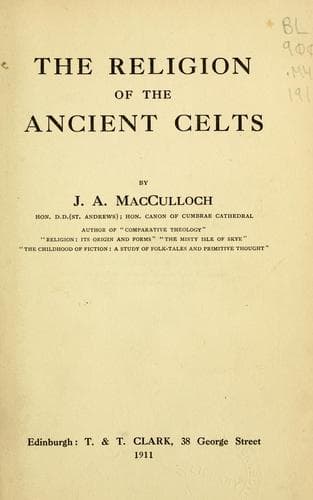
The Religion of the Ancient CeltsMacCulloch, J. A. (John Arnott)
Religion
The Religion of the Ancient Celts
MacCulloch, J. A. (John Arnott)
Celts -- Religion; Mythology, Celtic
Brian, Iuchar, and Iucharba, who give a title to the whole group, are
called _tri dee Donand_, "the three gods (sons of) Danu," or, again,
"gods of _dán_" (knowledge), perhaps as the result of a folk-etymology,
associating _dân_ with their mother's name Danu.[248] Various attributes
are personified as their descendants, Wisdom being son of all
three.[249] Though some of these attributes may have been actual gods,
especially Ecne or Wisdom, yet it is more probable that the
personification is the result of the subtleties of bardic science, of
which similar examples occur.[250] On the other hand, the fact that Ecne
is the son of three brothers, may recall some early practice of
polyandry of which instances are met with in the sagas.[251] M. D'Arbois
has suggested that Iuchar and Iucharba are mere duplicates of Brian, who
usually takes the leading place, and he identifies them with three kings
of the Tuatha Déa reigning at the time of the Milesian invasion--
MacCuill, MacCecht, and MacGrainne, so called, according to Keating,
because the hazel (_coll_), the plough (_cecht_), and the sun (_grian_)
were "gods of worship" to them. Both groups are grandsons of Dagda, and
M. D'Arbois regards this second group as also triplicates of one god,
because their wives Fotla, Banba, and Eriu all bear names of Ireland
itself, are personifications of the land, and thus may be "reduced to
unity."[252] While this reasoning is ingenious, it should be remembered
that we must not lay too much stress upon Irish divine genealogies,
while each group of three may have been similar local gods associated at
a later time as brothers. Their separate personality is suggested by the
fact that the Tuatha Dé Danann are called after them "the Men of the
Three Gods," and their supremacy appears in the incident of Dagda, Lug,
and Ogma consulting them before the fight at Mag-tured--a natural
proceeding if they were gods of knowledge or destiny.[253] The brothers
are said to have slain the god Cian, and to have been themselves slain
by Lug, and on this seems to have been based the story of _The Children
of Tuirenn_, in which they perish through their exertions in obtaining
the _eric_ demanded by Lug.[254] Here they are sons of Tuirenn, but more
usually their mother Danu or Brigit is mentioned.
Public-domain text, read in full here on John Shaqi.
Reviews
Reviews
No reviews yet
Be the first to share your thoughts on this work.
Elsewhere in the archive
Join the Discussion
Join the discussion
Sign in to leave a comment or review.
Sign InorCreate an account