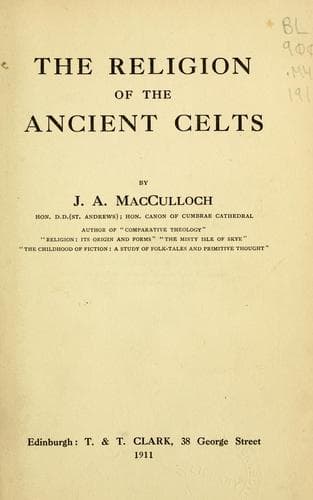
The Religion of the Ancient CeltsMacCulloch, J. A. (John Arnott)
Religion
The Religion of the Ancient Celts
MacCulloch, J. A. (John Arnott)
Celts -- Religion; Mythology, Celtic
Another son of Brigit's was Ogma, master of poetry and inventor of
_ogham_ writing, the word being derived from his name.[255] It is more
probable that Ogma's name is a derivative from some word signifying
"speech" or "writing," and that the connection with "ogham" may be a
mere folk-etymology. Ogma appears as the champion of the gods,[256] a
position given him perhaps from the primitive custom of rousing the
warriors' emotions by eloquent speeches before a battle. Similarly the
Babylonian Marduk, "seer of the gods," was also their champion in fight.
Ogma fought and died at Mag-tured; but in other accounts he survives,
captures Tethra's sword, goes on the quest for Dagda's harp, and is
given a _síd_ after the Milesian victory. Ogma's counterpart in Gaul is
Ogmíos, a Herakles and a god of eloquence, thus bearing the dual
character of Ogma, while Ogma's epithet _grianainech_, "of the smiling
countenance," recalls Lucian's account of the "smiling face" of
Ogmíos.[257] Ogma's high position is the result of the admiration of
bardic eloquence among the Celts, whose loquacity was proverbial, and to
him its origin was doubtless ascribed, as well as that of poetry. The
genealogists explain his relationship to the other divinities in
different ways, but these confusions may result from the fact that gods
had more than one name, of which the annalists made separate
personalities. Most usually Ogma is called Brigit's son. Her functions
were like his own, but in spite of the increasing supremacy of gods over
goddesses, he never really eclipsed her.
Among other culture gods were those associated with the arts and
crafts--the development of Celtic art in metal-work necessitating the
existence of gods of this art. Such a god is Goibniu, eponymous god of
smiths (Old Ir. _goba_, "smith"), and the divine craftsman at the battle
of Mag-tured, making spears which never failed to kill.[258] Smiths have
everywhere been regarded as uncanny--a tradition surviving from the
first introduction of metal among those hitherto accustomed to stone
weapons and tools. S. Patrick prayed against the "spells of women,
smiths, and Druids," and it is thus not surprising to find that Goibniu
had a reputation for magic, even among Christians. A spell for making
butter, in an eighth century MS. preserved at S. Gall, appeals to his
"science."[259] Curiously enough, Goibniu is also connected with the
culinary art in myth, and, like Hephaistos, prepares the feast of the
gods, while his ale preserves their immortality.[260] The elation
produced by heady liquors caused them to be regarded as draughts of
immortality, like Soma, Haoma, or nectar. Goibniu survives in tradition
as the _Gobhan Saer_, to whom the building of round towers is ascribed.
Public-domain text, read in full here on John Shaqi.
Reviews
Reviews
No reviews yet
Be the first to share your thoughts on this work.
Elsewhere in the archive
Join the Discussion
Join the discussion
Sign in to leave a comment or review.
Sign InorCreate an account