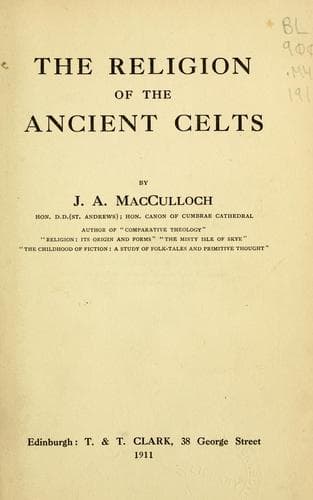
The Religion of the Ancient CeltsMacCulloch, J. A. (John Arnott)
Religion
The Religion of the Ancient Celts
MacCulloch, J. A. (John Arnott)
Celts -- Religion; Mythology, Celtic
Elsewhere we learn that this sacrifice in return for the gifts of corn
and milk from the god took place at Samhain, and that on one occasion
the violent prostrations of the worshippers caused three-fourths of them
to die. Again, "they beat their palms, they pounded their bodies ...
they shed falling showers of tears."[279] These are reminiscences of
orgiastic rites in which pain and pleasure melt into one. The god must
have been a god of fertility; the blood of the victims was poured on the
image, the flesh, as in analogous savage rites and folk-survivals, may
have been buried in the fields to promote fertility. If so, the victims'
flesh was instinct with the power of the divinity, and, though their
number is obviously exaggerated, several victims may have taken the
place of an earlier slain representative of the god. A mythic _Crom
Dubh_, "Black Crom," whose festival occurs on the first Sunday in
August, may be another form of Cromm Cruaich. In one story the name is
transferred to S. Patrick's servant, who is asked by the fairies when
they will go to Paradise. "Not till the day of judgment," is the answer,
and for this they cease to help men in the processes of agriculture. But
in a variant Manannan bids Crom ask this question, and the same result
follows.[280] These tales thus enshrine the idea that Crom and the
fairies were ancient gods of growth who ceased to help men when they
deserted them for the Christian faith. If the sacrifice was offered at
the August festival, or, as the texts suggest, at Samhain, after
harvest, it must have been on account of the next year's crop, and the
flesh may have been mingled with the seed corn.
Dagda may thus have been a god of growth and fertility. His wife or
mistress was the river-goddess, Boand (the Boyne),[281] and the children
ascribed to him were Oengus, Bodb Dearg, Danu, Brigit, and perhaps Ogma.
The euhemerists made him die of Cethlenn's venom, long after the battle
of Mag-tured in which he encountered her.[282] Irish mythology is
remarkably free from obscene and grotesque myths, but some of these
cluster round Dagda. We hear of the Gargantuan meal provided for him in
sport by the Fomorians, and of which he ate so much that "not easy was
it for him to move and unseemly was his apparel," as well as his conduct
with a Fomorian beauty. Another amour of his was with Morrigan, the
place where it occurred being still known as "The Couple's Bed."[283] In
another tale Dagda acts as cook to Conaire the great.[284]
Public-domain text, read in full here on John Shaqi.
Reviews
Reviews
No reviews yet
Be the first to share your thoughts on this work.
Elsewhere in the archive
Join the Discussion
Join the discussion
Sign in to leave a comment or review.
Sign InorCreate an account