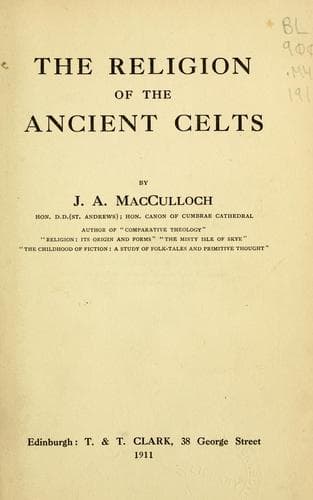
The Religion of the Ancient CeltsMacCulloch, J. A. (John Arnott)
Religion
The Religion of the Ancient Celts
MacCulloch, J. A. (John Arnott)
Celts -- Religion; Mythology, Celtic
The victory of the Tuatha Déa at the first battle of Mag-tured, in June,
their victory followed, however, by the deaths of many of them at the
second battle in November, may point to old myths dramatising the
phenomena of nature, and connected with the ritual of summer and winter
festivals. The powers of light and growth are in the ascendant in
summer; they seem to die in winter. Christian euhemerists made use of
these myths, but regarded the gods as warriors who were slain, not as
those who die and revive again. At the second battle, Nuada loses his
life; at the first, though his forces are victorious, his hand was cut
off by the Fomorian Sreng, for even when victorious the gods must
suffer. A silver hand was made for him by Diancecht, and hence he was
called Nuada _Argetlám_, "of the silver hand." Professor Rh[^y]s regards
him as a Celtic Zeus, partly because he is king of the Tuatha Dé Danann,
partly because he, like Zeus or Tyr, who lost tendons or a hand through
the wiles of evil gods, is also maimed.[295] Similarly in the _Rig-Veda_
the Açvins substitute a leg of iron for the leg of Vispala, cut off in
battle, and the sun is called "golden-handed" because Savitri cut off
his hand and the priests replaced it by one of gold. The myth of Nuada's
hand may have arisen from primitive attempts at replacing lopped-off
limbs, as well as from the fact that no Irish king must have any bodily
defect, or possibly because an image of Nuada may have lacked a hand or
possessed one of silver. Images were often maimed or given artificial
limbs, and myths then arose to explain the custom.[296] Nuada appears to
be a god of life and growth, but he is not a sun-god. His Welsh
equivalent is Llûd Llawereint, or "silver-handed," who delivers his
people from various scourges. His daughter Creidylad is to be wedded to
Gwythur, but is kidnapped by Gwyn. Arthur decides that they must fight
for her yearly on 1st May until the day of judgment, when the victor
would gain her hand.[297] Professor Rh[^y]s regards Creidylad as a
Persephone, wedded alternately to light and dark divinities.[298] But
the story may rather be explanatory of such ritual acts as are found in
folk-survivals in the form of fights between summer and winter, in which
a Queen of May figures, and intended to assist the conflict of the gods
of growth with those of blight.[299] Creidylad is daughter of a probable
god of growth, nor is it impossible that the story of the battle of
Mag-tured is based on mythic explanations of such ritual combats.
Public-domain text, read in full here on John Shaqi.
Reviews
Reviews
No reviews yet
Be the first to share your thoughts on this work.
Elsewhere in the archive
Join the Discussion
Join the discussion
Sign in to leave a comment or review.
Sign InorCreate an account