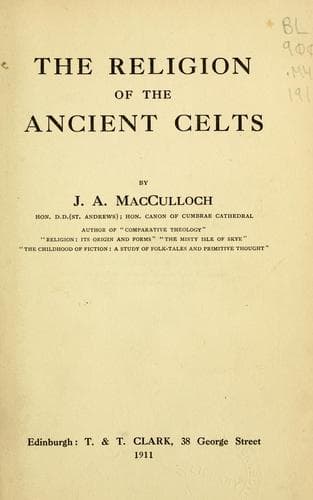
The Religion of the Ancient CeltsMacCulloch, J. A. (John Arnott)
Religion
The Religion of the Ancient Celts
MacCulloch, J. A. (John Arnott)
Celts -- Religion; Mythology, Celtic
[281] _RC_ xxvi. 19.
[282] _Annals of the Four Masters_, A.M. 3450.
[283] _RC_ xii. 83, 85; Hyde, _op. cit._ 288.
[284] _LU_ 94.
[285] _RC_ xii. 65. Elsewhere three supreme "ignorances" are ascribed to
Oengus (_RL_ xxvi. 31).
[286] _RC_ iii. 342.
[287] _LL_ 11_c_; _LU_ 129; _IT_ i. 130. Cf. the glass house, placed
between sky and moon, to which Tristan conducts the queen. Bedier,
_Tristan et Iseut_, 252. In a fragmentary version of the story Oengus is
Etain's wooer, but Mider is preferred by her father, and marries her. In
the latter half of the story, Oengus does not appear (see p. 363,
_infra_). Mr. Nutt (_RC_ xxvii. 339) suggests that Oengus, not Mider,
was the real hero of the story, but that its Christian redactors gave
Mider his place in the second part. The fragments are edited by Stirn
(_ZCP_ vol. v.).
[288] _HL_ 146.
[289] See my _Childhood of Fiction_, 114, 153. The tale has some unique
features, as it alone among Western _Märchen_ and saga variants of the
"True Bride" describes the malicious woman as the wife of Mider. In
other words, the story implies polygamy, rarely found in European
folk-tales.
[290] O'Grady, _TOS_ iii.
[291] _RC_ i. 41.
[292] O'Curry, _MC_ i. 71.
[293] _LL_ 117_a_. See p. 381, _infra_.
[294] Cumont, _RC_ xxvi. 47; D'Arbois, _RC_ xxvii. 127, notes the
difficulty of explaining the change of _e_ to _i_ in the names.
[295] _HL_ 121.
[296] See Crooke, _Folk-Lore_, viii. 341. Cf. Herod, ii. 131.
[297] Loth, i. 269.
[298] _HL_ 563.
[299] Train, _Isle of Man_, Douglas, 1845, ii. 118; Grimm, _Teut. Myth._
ii. ch. 24; Frazer, _GB_{2} ii. 99 f.
[300] Bathurst, _Roman Antiquities at Lydney Park_, 1879; Holder, _s.v._
"Nodons."
[301] See Rh[^y]s, _HL_ 122; Cook, _Folk-Lore_, xvii. 30.
[302] Stokes, _US_ 194-195; Rh[^y]s, _HL_, 128, _IT_ i. 712.
[303] Loth, ii. 235, 296. See p. 160, _infra_.
[304] Joyce, _OCR_.
[305] For these four Manannans see Cormac 114, _RC_ xxiv. 270, _IT_ iii.
357.
[306] O'Grady, ii.
[307] _Bodley Dindsenchas_, No. 10, _RC_ xii. 105; Joyce, _SH_ i. 259;
_Otia Merseiana_, ii. "Song of the Sea."
[308] _LU_ 133.
[309] Moore, 6.
[310] Geoffrey, _Vita Merlini_, 37; Rees, 435. Other saintly legends are
derived from myths, e.g. that of S. Barri in his boat meeting S.
Scuithne walking on the sea. Scuithne maintains he is walking on a
field, and plucks a flower to prove it, while Barri confutes him by
pulling a salmon out of the sea. This resembles an episode in the
meeting of Bran and Manannan (Stokes, _Félire_, xxxix.; Nutt-Meyer, i.
39). Saints are often said to assist men just as the gods did.
Columcille and Brigit appeared over the hosts of Erin assisting and
encouraging them _(RC_ xxiv. 40).
[311] _RC_ xii. 59.
[312] _Folk-Lore Journal_, v. 66; Rh[^y]s, _HL_ 314.
[313] Larminie, "Kian, son of Kontje."
[314] Joyce, _OCR_ 37.
Public-domain text, read in full here on John Shaqi.
Reviews
Reviews
No reviews yet
Be the first to share your thoughts on this work.
Elsewhere in the archive
Join the Discussion
Join the discussion
Sign in to leave a comment or review.
Sign InorCreate an account