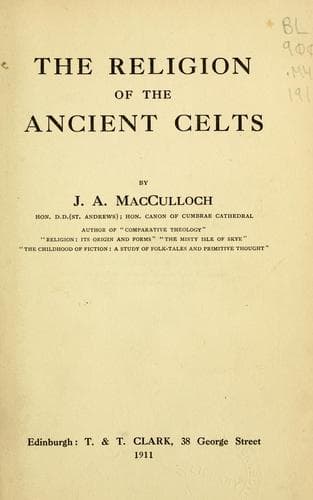
The Religion of the Ancient CeltsMacCulloch, J. A. (John Arnott)
Religion
The Religion of the Ancient Celts
MacCulloch, J. A. (John Arnott)
Celts -- Religion; Mythology, Celtic
Some of the personages bear similar names to the Irish divinities, and
in some cases there is a certain similarity of incidents to those of the
Irish tales.[329] Are, then, the gods dimly revealed in Welsh literature
as much Goidelic as Brythonic? Analysing the incidents of the
_Mabinogion_, Professor Anwyl has shown that they have an entirely local
character, and are mainly associated with the districts of Dyfed and
Gwent, of Anglesey, and of Gwynedd, of which Pryderi, Branwen, and
Gwydion are respectively the heroic characters.[330] These are the
districts where a strong Goidelic element prevailed, whether these
Goidels were the original inhabitants of Britain, driven there by
Brythons,[331] or tribes who had settled there from Ireland,[332] or
perhaps a mixture of both. In any case they had been conquered by
Brythons and had become Brythonic in speech from the fifth century
onwards. On account of this Goidelic element, it has been claimed that
the personages of the _Mabinogion_ are purely Goidelic. But examination
proves that only a few are directly parallel in name with Irish
divinities, and while here there are fundamental likenesses, the
_incidents_ with Irish parallels may be due to mere superficial
borrowings, to that interchange of _Märchen_ and mythical _données_
which has everywhere occurred. Many incidents have no Irish parallels,
and most of the characters are entirely different in name from Irish
divinities. Hence any theory which would account for the likenesses,
must also account for the differences, and must explain why, if the
_Mabinogion_ is due to Irish Goidels, there should have been few or no
borrowings in Welsh literature from the popular Cúchulainn and Ossianic
sagas,[333] and why, at a time when Brythonic elements were uppermost,
such care should have been taken to preserve Goidelic myths. If the
tales emanated from native Welsh Goidels, the explanation might be that
they, the kindred of the Irish Goidels, must have had a certain
community with them in divine names and myths, while others of their
gods, more local in character, would differ in name. Or if they are
Brythonic, the likenesses might be accounted for by an early community
in myth and cult among the common ancestors of Brythons and
Goidels.[334] But as the date of the composition of the _Mabinogion_ is
comparatively late, at a time when Brythons had overrun these Goidelic
districts, more probably the tales contain a mingling of Goidelic (Irish
or Welsh) and Brythonic divinities, though some of these may be
survivals of the common Celtic heritage.[335] Celtic divinities were
mainly of a local, tribal character. Hence some would be local Goidelic
divinities, others, classed with these, local Brythonic divinities. This
would explain the absence of divinities and heroes of other local
Brythonic groups, e.g. Arthur, from the _Mabinogion_. But with the
growing importance of these, they attracted to their legend the folk of
the _Mabinogion_ and other tales.
Public-domain text, read in full here on John Shaqi.
Reviews
Reviews
No reviews yet
Be the first to share your thoughts on this work.
Elsewhere in the archive
Join the Discussion
Join the discussion
Sign in to leave a comment or review.
Sign InorCreate an account