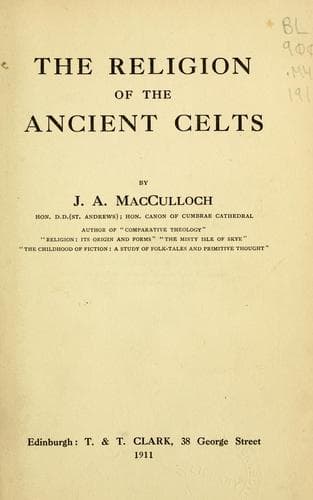
The Religion of the Ancient CeltsMacCulloch, J. A. (John Arnott)
Religion
The Religion of the Ancient Celts
MacCulloch, J. A. (John Arnott)
Celts -- Religion; Mythology, Celtic
Math or Math Hen, "the Ancient,"[367] is probably an old divinity of
Gwyned, of which he is called lord. He is a king and a magician,
pre-eminent in wizardry, which he teaches to Gwydion, and in a _Triad_
he is called one of the great men of magic and metamorphosis of
Britain.[368] More important are his traits of goodness to the
suffering, and justice with no trace of vengeance to the wrong-doer.
Whether these are derived from his character as a god or from the Celtic
kingly ideal, it is impossible to say, though the former is by no means
unlikely. Possibly his supreme magical powers make him the equivalent of
the Irish "god of Druidism," but this is uncertain, since all gods were
more or less dowered with these.
Gwydion's magical powers are abundantly illustrated in the tale. At
Pryderi's court he changes fungus into horses and dogs, and afterwards
slays Pryderi by power of enchantments; he produces a fleet by magic
before Arianrhod's castle; with Math's help he forms Blodeuwedd out of
flowers; he gives Llew his natural shape when he finds him as a wasted
eagle on a tree, his flesh and the worms breeding in it dropping from
him; he transforms the faithless Blodeuwedd into an owl. Some of these
and other deeds are referred to in the _Taliesin_ poems, while Taliesin
describes himself as enchanted by Gwydion.[369] In the _Triads_ he is
one of the three great astrologers of Prydein, and this emphasis laid on
his powers of divination is significant when it is considered that his
name may be derived from a root _vet_, giving words meaning "saying" or
"poetry," while cognate words are Irish _fáith_, "a prophet" or "poet,"
German _wuth_, "rage," and the name of Odinn.[370] The name is
suggestive of the ecstasy of inspiration producing prophetic and poetic
utterance. In the _Mabinogion_ he is a mighty bard, and in a poem, he,
under the name of Gweir, is imprisoned in the Other-world, and there
becomes a bard, thus receiving inspiration from the gods' land.[371] He
is the ideal _fáith_--diviner, prophet, and poet, and thus the god of
those professing these arts. Strabo describes how the Celtic _vates_
(_fáith_) was also a philosopher, and this character is given in a poem
to Seon (probably = Gwydion), whose artists are poets and
magicians.[372] But he is also a culture-god, bringing swine to men from
the gods' land. For though Pryderi is described as a mortal who has
himself received the swine from Annwfn (Elysium), there is no doubt that
he himself was a lord of Annwfn, and it was probably on account of
Gwydion's theft from Annwfn that he, as Gweir, was imprisoned there
"through the messenger of Pwyll and Pryderi."[373] A raid is here made
directly on the god's land for the benefit of men, and it is
unsuccessful, but in the _Mabinogi_ a different version of the raid is
told. Perhaps Gwydion also brought kine from Annwfn, since he is called
one of the three herds of Britain,[374] while he himself may once have
Public-domain text, read in full here on John Shaqi.
Reviews
Reviews
No reviews yet
Be the first to share your thoughts on this work.
Elsewhere in the archive
Join the Discussion
Join the discussion
Sign in to leave a comment or review.
Sign InorCreate an account