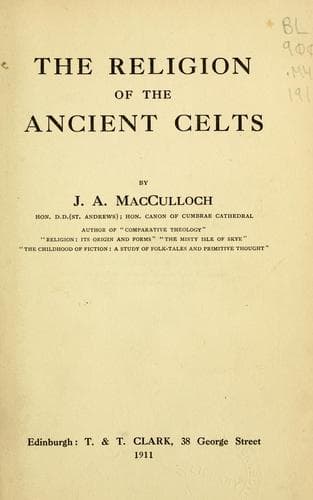
The Religion of the Ancient CeltsMacCulloch, J. A. (John Arnott)
Religion
The Religion of the Ancient Celts
MacCulloch, J. A. (John Arnott)
Celts -- Religion; Mythology, Celtic
Pryderi, as has been seen, was despoiled of his swine by Gwydion. They
were the gift of Arawn, but in the _Triads_ they seem to have been
brought from Annwfn by Pwyll, while Pryderi acted as swineherd.[399]
Both Pwyll and Pryderi are thus connected with those myths which told of
the bringing of domestic animals from the gods' land. But since they are
certainly gods, associated with the gods' land, this is perhaps the
result of misunderstanding. A poem speaks of the magic cauldron of Pen
Annwfn, i.e. Pwyll, and this points to a myth explaining his connection
with Annwfn in a different way from the account in the _Mabinogi_. The
poem also tells how Gweir was imprisoned in Caer Sidi (=Annwfn) "through
the messenger of Pwyll and Pryderi."[400] They are thus lords of Annwfn,
whose swine Gweir (Gwydion) tries to steal. Elsewhere Caer Sidi is
associated with Manawyddan and Pryderi, perhaps a reference to their
connection as father and son.[401] Thus Pryderi and Pwyll belong to the
bright Elysium, and may once have been gods of fertility associated with
the under-earth region, which was by no means a world of darkness.
Whatever be the meaning of the death of Pryderi at the hands of Gwydion,
it is connected with later references to his grave.[402]
A fourth group is that of Beli and his sons, referred to in the
_Mabinogi_ of Branwen, where one of them, Caswallawn, usurps the throne,
and thus makes Manawyddan, like MacGregor, landless. In the _Dream of
Maxen_, the sons of Beli are Lludd, Caswallawn, Nynnyaw, and
Llevelys.[403] Geoffrey calls Beli Heli, and speaks of an earlier king
Belinus, at enmity with his brother Brennius.[404] But probably Beli or
Heli and Belinus are one and the same, and both represent the earlier
god Belenos. Caswellawn becomes Cassivellaunus, opponent of Cæsar, but
in the _Mabinogi_ he is hostile to the race of Llyr, and this may be
connected with whatever underlies Geoffrey's account of the hostility of
Belinus and Brennius (=Bran, son of Llyr), perhaps, like the enmity of
the race of D[^o]n to Pryderi, a reminiscence of the strife of rival
tribes or of Goidel and Brython.[405] As has been seen, the evidence for
regarding Beli as D[^o]n's consort or the equivalent of Bile is slender.
Nor, if he is Belenos, the equivalent of Apollo, is he in any sense a
"dark" god. He is regarded as a victorious champion, preserver of his
"honey isle" and of the stability of his kingdom, in a _Taliesin_ poem
and in the _Triads_.[406]
The personality of Casswallawn is lost in that of the historic
Cassivellaunus, but in a reference to him in the _Triads_ where, with
Caradawc and Gweirydd, he bears the title "war king," we may see a
glimpse of his divine character, that of a god of war, invisibly leading
on armies to battle, and as such embodied in great chiefs who bore his
name.[407] Nynnyaw appears in Geoffrey's pages as Nennius, who dies of
wounds inflicted by Cæsar, to the great grief of Cassivellaunus.[408]
Public-domain text, read in full here on John Shaqi.
Reviews
Reviews
No reviews yet
Be the first to share your thoughts on this work.
Elsewhere in the archive
Join the Discussion
Join the discussion
Sign in to leave a comment or review.
Sign InorCreate an account