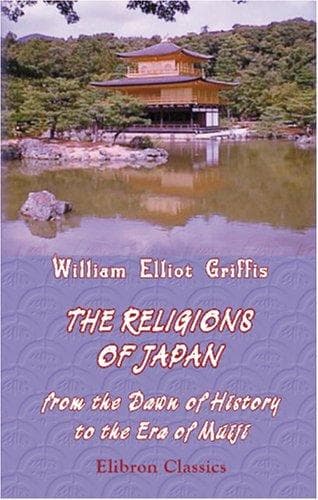
The Religions of Japan, from the Dawn of History to the Era of MéijiGriffis, William Elliot
Religion
The Religions of Japan, from the Dawn of History to the Era of Méiji
Griffis, William Elliot
Japan -- Religion
Let us glance again at this Nepal Buddhism. In the tenth century we find
what at first seems to be a growth out of Polytheism into Monotheism,
for a new Being, to whom the attributes of infinity, self-existence and
omniscience are ascribed, is invented and named Adi-Buddha, or the
primordial Buddha. According to the speculations of the thinkers, he had
evolved himself out of the five Dhyani-Buddhas by the exercise of the
five meditations, while each of these had evolved out of itself by
wisdom and contemplation, the corresponding Buddhas elect. Again, each
of the latter evolved out of his own essence a material world,--our
present world being the fourth of these, that is of Avaloki. One almost
might consider that this setting forth of the primordial Buddha was real
Monotheism; but on looking more carefully one sees that it is as little
real Monotheism as was possible in the system of Gnosticism. Indeed the
force of evolution could not stop here; for, since even this primordial
Buddha rested upon Ossa of hypothesis piled upon Pelion of hypothesis,
there must be other hypotheses yet to come, and so the Tantra system, a
compound of old Brahminism with the magic and witchcraft and Shamanism
of Northern Asia burst into view. As this was to travel into Japan and
be hailed as purest Buddhism, let us note how this tenth century Tantra
system grew up. To see this clearly, is to look upon the parable of the
man with the unclean spirit being acted out on a vast scale in history.
In the sixth century of our era, one Asanga, or Asamga, wrote the
Shastra, called the Shastra Yoga-chara Bhumi.[28] With great dexterity
he erected a sort of clearing-house for both the corrupt Brahminism and
corrupt Buddhism of his day, and exchanging and rearranging the gods and
devils in both systems, he represented them as worshippers and
supporters of the Buddha and Avalokitesvara. In such a system, the old
primitive Buddhism of the noble eight-fold path of self-conquest and
pure morals was utterly lost. Instead of that, the worshipper gave his
whole powers to obtaining occult potencies by means of magic phrases and
magic circles. Then grew up whole forests of monasteries and temples,
with an outburst of devilish art representing many-headed and many-eyed
and many-handed idols on the walls, on books, on the roadside, with
manifold charms and phrases the endless repetitions of which were
supposed to have efficacy with the hypothetical being who filled the
heavens. That was _the_ age of idols for China as well as for India; and
the old Chinese house, once empty, swept and garnished by Confucianism,
was now filled with a mob of unclean spirits each worse than the first.
With more courageous logic than the more matter-of-fact Chinese, the
Tibetan erected his prayer-mills[29] and let the winds of heaven and the
flowing waters continually multiply his prayers and holy syllables. And
these inventions were duly imported into Japan, and even now are far
from being absent.[30]
Public-domain text, read in full here on John Shaqi.
Reviews
Reviews
No reviews yet
Be the first to share your thoughts on this work.
Elsewhere in the archive
Join the Discussion
Join the discussion
Sign in to leave a comment or review.
Sign InorCreate an account