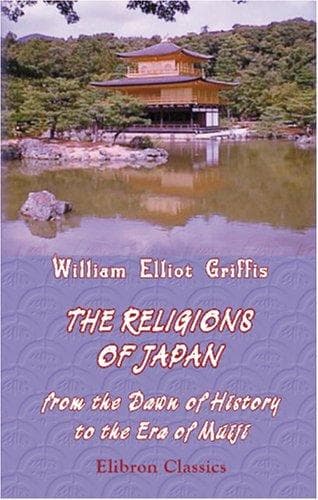
The Religions of Japan, from the Dawn of History to the Era of MéijiGriffis, William Elliot
Religion
The Religions of Japan, from the Dawn of History to the Era of Méiji
Griffis, William Elliot
Japan -- Religion
In the same year, the Mikado called for contributions from all the
people for the building of a colossal image of the Buddha, which was to
be of bronze and gilded. Yet, fearing that the Shintō gods might be
offended, a skilful priest named Giyoku,--probably the same man who
introduced the potter's wheel into Japan,--was sent to the shrine of the
Sun-goddess in Isé to present her with a shari or relic of the Buddha,
and find out how she would regard his project. After seven days and
nights of waiting, the chapel doors flew open and the loud-voiced oracle
was interpreted in a favorable sense. The night following the return of
the priest, the Mikado dreamed that the sun-goddess appeared to him in
her own form and said "The sun is Birushana" (Vairokana). This meant
that the chief deity of the Japanese proclaimed herself an avatar or
incarnation of one of the old Hindu gods.[35] She also approved the
project of the image; and in this same year, 759, native gold was found
in Japan, which sufficed for the gilding of the great idol that, after
eleven hundred years and many vicissitudes, still stands, the glory of a
multitude of pilgrims.
In A.D. 754 a famous priest, who introduced the new Ritsu Sect, was able
to convert the Mikado and obtain four hundred converts in the imperial
court. Thirteen years later, another tremendous triumph of Buddhism was
scored and a deadly blow at Shintō was struck. The Buddhist priests
persuaded the Mikados to abandon their ancient title of Sumeru and adopt
that of Tennō (Heavenly King or Tenshi) Son of Heaven, after the
Chinese fashion. At the same time it was taught that the emperor could
gain great merit and sooner become a Buddha, by retiring from the active
cares of the throne and becoming a monk, with the title of Hō-ō,
or Cloistered Emperor. This innovation had far-reaching consequences,
profoundly altering the status of the Mikado, giving sensualism on the
one hand and priestcraft on the other, their coveted opportunity,
changing the ruler of the nation from an active statesman into a recluse
and the recluse into a pious monk, or a licentious devotee, as the case
might be. It paved the way for the usurpation of the government by the
unscrupulous soldier, "the man on horseback," who was destined to rule
Japan for seven hundred years, while the throne and its occupant were in
the shadow. One of a thousand proofs of the progress of the propaganda
scheme is seen in the removal of the Shintō temple which had stood at
Nikkō, and the erection in its place of a Buddhist temple. In A.D.
805 the famous Tendai, and in 806 the powerful Shingon Sect were
introduced. All was now ready in Japan for the growth not only of one
new Buddhism, but of several varieties among the Northern Buddhisms
which so arouse the astonishment of those who study the simple Pali
scriptures that contain the story of Gautama, and who know only the
southern phase of the faith, that is to Asia, relatively, what
Christianity is to Europe.
Public-domain text, read in full here on John Shaqi.
Reviews
Reviews
No reviews yet
Be the first to share your thoughts on this work.
Elsewhere in the archive
Join the Discussion
Join the discussion
Sign in to leave a comment or review.
Sign InorCreate an account