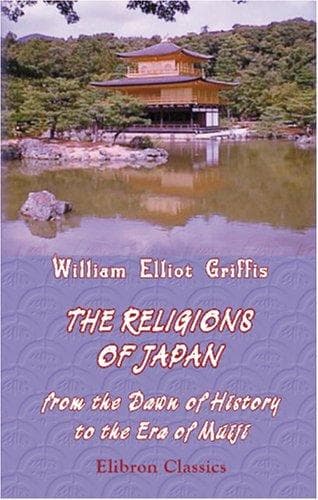
The Religions of Japan, from the Dawn of History to the Era of MéijiGriffis, William Elliot
Religion
The Religions of Japan, from the Dawn of History to the Era of Méiji
Griffis, William Elliot
Japan -- Religion
(2) To the Shintōist, who hated Buddhism and the Riyōbu Shintō
which had overlaid his ancestral faith, and who scorned and tabooed this
Chinese term Dai Miō Jin, this or that image represented a divine
ancestor whose name had in it many Japanese syllables, with no defiling
Chinese sounds, and who was the Kami or patron deity of this or that
neighborhood.
(3) To the Buddhist, this or that personage, in his lifetime, in the
early ages of Japanese history, had been an avatar of Buddha who had
appeared in human flesh and brought blessings to the people and
neighborhood; yet the people of the early ages being unprepared to
receive his doctrine or revelation, he had not then revealed or preached
it; but now, as for a thousand years since the time of the illustrious
and saintly Kōbō, he had his right name and received his just
honors and worship as an avatar of the eternal Buddha. So, although
Buddhist and Shintōist might quarrel as to his title, and divide,
even to anger, on minor points, they would both agree in letting the
common people take their pleasure, enjoy the festivals and merriment,
and preserve their reverence and worship.
(4) Still another spectator studied with critical interest the swaying
figure high in air. With a taste for archaeology, he admired the
accuracy of the drapery and associations. He was amused, it may be, with
occasional anachronisms as to garments or equipments. He knew that the
original of this personage had been nothing more than a human being, who
might indeed have been conspicuous as a brave soldier in war, or as a
skilful physician who helped to stop the plague, or as a civilizer who
imported new food or improved agriculture.
In a word, had this subject of the ancient Mikado lived in modern
Christendom, he might be honored through the government, patent office,
privy council, the admiralty, the university, or the academy, as the
case or worth might be. He might shine in a plastic representation by
the sculptor or artist, or be known in the popular literature; but he
would never receive religious worship, or aught beyond honor and praise.
In this swamping of history in legend and of fact in dogma, we behold
the fruit of Kōbō's work, Riyōbu Buddhism.
Kōbō's Work Undone.
Public-domain text, read in full here on John Shaqi.
Reviews
Reviews
No reviews yet
Be the first to share your thoughts on this work.
Elsewhere in the archive
Join the Discussion
Join the discussion
Sign in to leave a comment or review.
Sign InorCreate an account