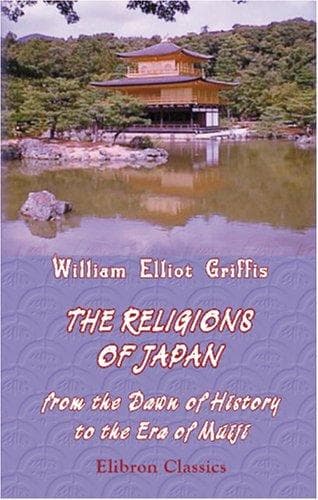
The Religions of Japan, from the Dawn of History to the Era of MéijiGriffis, William Elliot
Religion
The Religions of Japan, from the Dawn of History to the Era of Méiji
Griffis, William Elliot
Japan -- Religion
III. This was succeeded by another explosion of doctrine wholly and
peculiarly Japanese, and by a wide missionary propagation.
IV. From the sixteenth to the nineteenth century, there is little that
is doctrinally noticeable, until our own time, when the new Buddhism of
to-day claims at least a passing notice.
The Japanese writers of ecclesiastical history classify in three groups
the twelve great sects as the first six, the two mediæval, and the four
modern sects.
In this lecture we shall merely summarize the characteristics of the
first five sects which existed before the opening of the ninth century
but which are not formally extant at the present time, and treat more
fully the purely Japanese developments. The first three sects may be
grouped under the head of the Hinayana, or Smaller Vehicle, as Southern
or primitive orthodox Buddhism is usually called.
Most of the early sects, as will be seen, were founded upon some
particular sutra, or upon selections or collections of sutras. They
correspond to some extent with the manifold sects of Christendom, and
yet this illustration or reference must not be misleading. It is not as
though a new Christian sect, for example, were in A.D. 500 to be formed
wholly on the gospel of Luke, or the book of the Revelation; nor as
though a new sect should now arise in Norway or Tennessee because of a
special emphasis laid on a combination of the epistle to the Corinthians
and the book of Daniel. It is rather as though distinct names and
organizations should be founded upon the writings of Tertullian, of
Augustine, of Luther, or of Calvin, and that such sects should accept
the literary work of these scholars not only as commentaries but as Holy
Scripture itself.
The Buddhist body of scriptures has several times been imported and
printed in Japan, but has never been translated into the vernacular. The
canon[1] is not made up simply of writings purporting to be the words of
Buddha or of the apostles who were his immediate companions or
followers. On the contrary, the canon, as received in Japan, is made up
of books, written for the most part many centuries after the last of the
contemporaries of Gautama had passed away. Not a few of these writings
are the products of the Chinese intellect. Some books held by particular
sects as holy scripture were composed in Japan itself, the very books
themselves being worshipped. Nevertheless those who are apparently
farthest away from primitive Buddhism, claim to understand Buddha most
clearly.
The Standard Doctrinal Work.
Public-domain text, read in full here on John Shaqi.
Reviews
Reviews
No reviews yet
Be the first to share your thoughts on this work.
Elsewhere in the archive
Join the Discussion
Join the discussion
Sign in to leave a comment or review.
Sign InorCreate an account