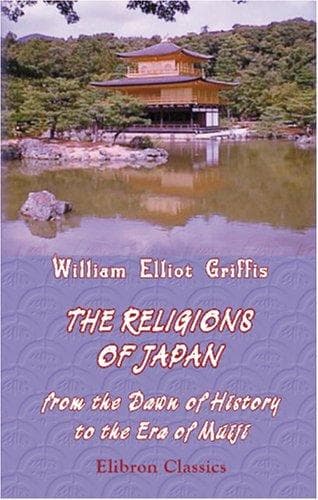
The Religions of Japan, from the Dawn of History to the Era of MéijiGriffis, William Elliot
Religion
The Religions of Japan, from the Dawn of History to the Era of Méiji
Griffis, William Elliot
Japan -- Religion
Space and time--which seem never to fail the Buddhists in their
literature--would fail us to describe this sect in full, or to show in
detail its teachings, wherein are wonderful resemblances to European
ideas and facts--in philosophy, to Hegel and Spinoza find in history, to
Jesuitism. Nor can we stay to point out the many instances in which,
invading the domain of politics, the Ten-dai abbots with their armies of
monks, having made their monasteries military arsenals and issuing forth
clad in armor as infantry and cavalry, have turned the scale of battle
or dictated policies to emperors. Like the Praetorian guard of Rome or
the clerical militia in Spain, these men of keen intellect have left
their marks deep upon the social and political history of the country in
which they dwelt. They have understood thoroughly the art of practising
religion for the sake of revenue. To secure their ends, priests have
made partnerships with other sects; in order to hold Shintō shrines,
they have married to secure heirs and make office hereditary; and
finally in the Purification of 1870, when the Riyōbu system was blown
to the winds by the Japanese Government, not a few priests of this sect
became laymen, in order to keep both office and emolument in the
purified Shintō shrines.
The Sect of the True Word.
It is probable that the conquest and obliteration of Shintō might
have been accomplished by some priest or priests of the Ten-dai sect,
had such a genius as Kōbō been found in its household; but this
great achievement was reserved for the man who introduced into Japan the
Shin-gon Shu, or Sect of the True Word. The term _gon_ is the equivalent
of Mantra,[20] a Sanskrit term meaning word, but in later use referring
to the mystic salutations addressed to the Buddhist gods. "The doctrine
of this sect is a great secret law. It teaches us that we can attain to
the state of the 'Great Enlightened,' that is the state of 'Buddha,'
while in the present physical body, which was born of our parents (and
which consists of six elements,[21] Earth, Water, Fire, Wind, Ether, and
Knowledge), if we follow the three great secret laws, regarding Body,
Speech, and Thought."[22]
The history of the transmission of the doctrine from the greatest of the
spirit-bodied Buddhas to the historic founder, Vagrabodhi, is carefully
given. The latter was a man very learned in regard to many doctrines of
Buddhism and other religious, and was especially well acquainted with
the deepest meaning of the doctrine of this sect, which he taught in
India for a considerable time. The doctrine is recorded in several
sutras, yet the essential point is nothing but the Mandala, or circle of
the two parts, or, in Japanese, Riyōbu.
Public-domain text, read in full here on John Shaqi.
Reviews
Reviews
No reviews yet
Be the first to share your thoughts on this work.
Elsewhere in the archive
Join the Discussion
Join the discussion
Sign in to leave a comment or review.
Sign InorCreate an account