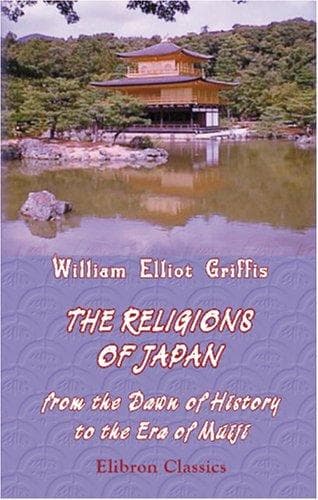
The Religions of Japan, from the Dawn of History to the Era of MéijiGriffis, William Elliot
Religion
The Religions of Japan, from the Dawn of History to the Era of Méiji
Griffis, William Elliot
Japan -- Religion
"By reason of the conferring on us sentient creators of this
great goodness and great merit through the utterance of the
Prayer, and the bestowal [by Amida] the evil Karma and [effect
of the] passions accumulated through the long Kalpas, since when
there was no beginning, are in a moment annihilated, and in
consequence, those passions and evil Karma of ours all
disappearing, we live already in the condition of the steadfast,
who do not return [to revolve in the cycle of Birth and
Death]."--Rennyō of the Shin sect, 1473.
"In the beginning was the Word, and the Word was with God, and
the Word was God."--John.
"The Father of lights, with whom there is no variableness,
neither shadow of turning."--James.
CHAPTER IX - THE BUDDHISM OF THE JAPANESE
The Western Paradise.
We cannot take space to show how, or how much, or whether at all,
Buddhism was affected by Christianity, though it probably was. Suffice
it to say that the Jō-dō Shu, or Sect of the Pure Land, was the
first of the many denominations in Buddhism which definitely and clearly
set forth that especial peculiarity of Northern Buddhism, the Western
Paradise. The school of thought which issued in Jō-dō Shu was
founded by the Hindoo, Memio. In A.D. 252 an Indian scholar, learned in
the Tripitaka, came to China, and translated one of the great sutras,
called Amitayus. This sutra gives a history of Tathagata Amitabha,[1]
from the first spiritual impulses which led him to the attainment of
Buddha-hood in remote Kalpas down to the present time, when he dwells in
the Western World, called the Happy, where he receives all living beings
from every direction, helping them to turn away from confusion and to
become enlightened.[2] The apocalyptic twentieth chapter of the Hokké
Kiō is a glorification of the transcendent power of the Tathagatas,
expressed in flamboyant oriental rhetoric.
Public-domain text, read in full here on John Shaqi.
Reviews
Reviews
No reviews yet
Be the first to share your thoughts on this work.
Elsewhere in the archive
Join the Discussion
Join the discussion
Sign in to leave a comment or review.
Sign InorCreate an account