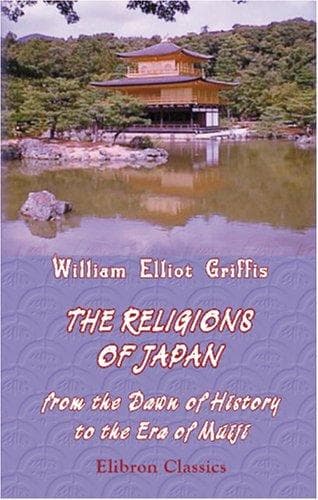
The Religions of Japan, from the Dawn of History to the Era of MéijiGriffis, William Elliot
Religion
The Religions of Japan, from the Dawn of History to the Era of Méiji
Griffis, William Elliot
Japan -- Religion
Moreover, it is not easy to accomplish the cause and effect of the Holy
Path, but both those of the doctrine of the Pure Land are very easy to
be completed. The difference is like that between travelling by land and
travelling by water.[6] The doctrines preached by the Buddha are
eighty-four thousand in number; that is to say, he taught one kind of
people one system, that of the Holy Path, and another kind that of the
Pure Land. The Pure Land doctrine of Hō-nen was derived from the
sutra preached by the great teacher Shaka.
This simple doctrine of "land travel to Paradise" was one which the
people of Japan could easily understand, and it became amazingly
popular. Salvation along this route is a case of being "carried to the
skies on flowery beds of ease, while others sought to win the prize and
sailed through bloody seas."
Largely through the influence of Jō-dō Shu and of those sects most
closely allied to it, the technical terms, peculiar phraseology and
vocabulary of Buddhism became part of the daily speech of the Japanese.
When one studies their language he finds that it is a complicated
organism, including within itself several distinct systems. Just as the
human body harmonizes within itself such vastly differing organized
functions as the osseous, digestive, respiratory, etc., so, embedded in
what is called the Japanese language, there are, also, a Chinese
vocabulary, a polite vernacular, one system of expression for superiors,
another for inferiors, etc. Last of all, there is, besides a peculiar
system of pronunciation taught by the priests, a Buddhist language,
which suggests a firmament of starry and a prairie of flowery metaphors,
with intermediate deeps of space full of figurative expressions.
In our own mother tongue we have something similar. The dialect of
Canaan, the importations of Judaism, the irruptions of Hebraic idioms,
phrases and names into Puritanism, and the ejaculations of the
camp-meeting, which vein and color our English speech, may give some
idea of the variegated strains which make up the Japanese language.
Further, the peculiar nomenclature of the Fifth Monarchy men, is fully
paralleled in the personal names of priests and even of laymen in Japan.
Characteristics of the Jō-dō Sect.
Hō-nen teaches that the solution of abstract questions and doctrinal
controversies is not needed as means of grace to promote the work of
salvation. Whether the priests and their followers were learned and
devout, or the contrary, mattered little as regards the final result, as
all that is necessary is the continual repetition of the prayer to
Amida.
Public-domain text, read in full here on John Shaqi.
Reviews
Reviews
No reviews yet
Be the first to share your thoughts on this work.
Elsewhere in the archive
Join the Discussion
Join the discussion
Sign in to leave a comment or review.
Sign InorCreate an account