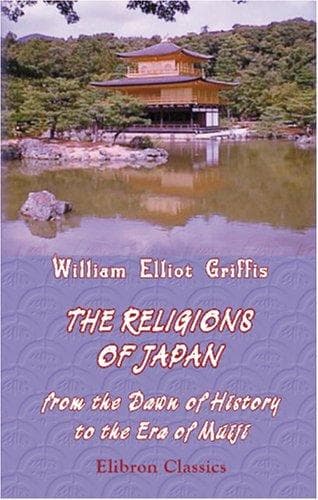
The Religions of Japan, from the Dawn of History to the Era of MéijiGriffis, William Elliot
Religion
The Religions of Japan, from the Dawn of History to the Era of Méiji
Griffis, William Elliot
Japan -- Religion
The whole tendency of Japanese Buddhism and its full momentum were now
toward the development of doctrine even to startling proportions.
Instead of the ancient path of asceticism and virtue with agnosticism
and atheism, we see the means of salvation put now, and perhaps too
easily, within the control of all. The pathway to Paradise was made not
only exceedingly plain, but also extremely easy, perhaps even
ridiculously so; while the door was open for an outburst of new and
local doctrines unknown to India, or even to China. The rampant vigor
with which Japanese Buddhism began to absorb everything in heaven, earth
and sea, which it could make a worshipable object or cause to stand as a
Kami or deity to the mind, will be seen as we proceed. The native
proverb, instead of being an irreverent joke, stands for an actual
truth--"Even a sardine's head may become an object of worship."
"Reformed" Buddhism.
We now look at what foreigners call "Reformed" Buddhism, which some even
imagine has been borrowed from Protestant Christianity--notwithstanding
that it is centuries older than the Reformation in Europe.
The Shin Shu or True Sect, though really founded on the Jō-dō
doctrines, is separate from the sect of the Pure Land. Yet, besides
being called the Shin Shu, it is also spoken of as the Jō-dō Shin
Shu or the True Sect of the Pure Land. It is the extreme form of the
Protestantism of Buddhism. It lays emphasis on the idea of salvation
wholly through the merits of another, but it also paints in richer tints
the sensuous delights of the Western Paradise. As the term Pure Land is
antithetical to that of the Holy Path, so the word Shin, or True,
expresses the contrary of what are termed the "temporary expedients."
While some say that we should practise good works, bring our stock of
merits to maturity, and be born in the Pure Land, others say that we
need only repeat the name of Amida in order to be born in the Pure Land,
by the merit produced from such repetition. These doctrines concerning
repetitions, however, are all considered but "temporary expedients." So
also is the rigid classification, so prominent in "the old sects," of
all beings or pupils into three grades. As in Islam or Calvinism, all
believers stand on a level. To Shin-ran the Radical, the practices even
of Jō-dō seemed complicated and difficult, and all that appeared
necessary to him was faith in the desire of Amida to bless and save. To
Shinran,[9] faith was the sole saving act.
To rely upon the power of the Original Prayer of Amitabha Buddha with
the whole heart and give up all idea of _ji-riki_ or self-power, is
called the truth. This truth is the doctrine of this sect of Shin.[10]
In a word, not synergism, not faith _and_ works, but faith only is the
teaching of Shin Shu.
Public-domain text, read in full here on John Shaqi.
Reviews
Reviews
No reviews yet
Be the first to share your thoughts on this work.
Elsewhere in the archive
Join the Discussion
Join the discussion
Sign in to leave a comment or review.
Sign InorCreate an account