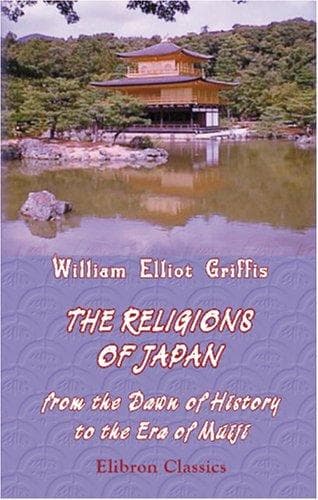
The Religions of Japan, from the Dawn of History to the Era of MéijiGriffis, William Elliot
Religion
The Religions of Japan, from the Dawn of History to the Era of Méiji
Griffis, William Elliot
Japan -- Religion
So also _in_ regard to the sacred writings, Shinran opposed the San-ron
school and the three-grade idea. The scriptures of other sects are in
Sanskrit and Chinese, which only the learned are able to read. The
special writings of Shinran are in the vernacular. Three of the sutras,
also, have been translated into Japanese and expressed in the kana
script. Singleness of purpose characterised this sect, which was often
called Monto, or followers of the gate, in reference to its unity of
organization, and the opening of the way to all by Shinran and the
doctrine taught by him. Yet, lest the gate might seem too broad, the
Shin teachers insist that morality is as important as faith, and indeed
the proof of it. The high priests of Shin Shu have ever held a high
position and wielded vast influence in the religious development of the
people. While the temples of other sects are built in sequestered places
among the hills, those of Shin Shu are erected in the heart of cities,
on the main streets, and at the centres of population,--the priests
using every means within their power to induce the people to come to
them. The altars are on an imposing scale of magnificence and gorgeous
detail. No Roman Catholic church or cathedral can outshine the splendor
of these temples, in which the way to the Western Paradise is made so
clear and plain. Another name for the sect is Ikko.
After the death of Shinran, his youngest daughter and one of his
grandsons erected a monastery near his tomb in the eastern suburbs of
Kiōto, to which the Mikado gave the title of Hon-guanji, or Monastery
of the Original Vow. This was in allusion to the vow made by Amida, that
he would not accept Buddhaship except under the condition that salvation
be made attainable for all who should sincerely desire to be born into
his kingdom, and signify their desire by invoking his name ten
times.[11] It is upon the passage in the sutra where this vow is
recorded, that the doctrine of the sect is based. Its central idea is
that man is to be saved by faith in the mercy of the boundlessly
compassionate Amida, and not by works or vain repetitions. Within our
own time, on November 28, 1876, the present reigning Mikado bestowed
upon Shinran the posthumous title Ken-shin Dai-shi, or Great Teacher of
the Revelation of Truth.
The Protestants of Japanese Buddhism.
Public-domain text, read in full here on John Shaqi.
Reviews
Reviews
No reviews yet
Be the first to share your thoughts on this work.
Elsewhere in the archive
Join the Discussion
Join the discussion
Sign in to leave a comment or review.
Sign InorCreate an account