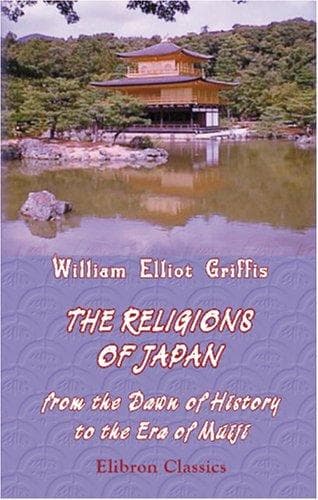
The Religions of Japan, from the Dawn of History to the Era of MéijiGriffis, William Elliot
Religion
The Religions of Japan, from the Dawn of History to the Era of Méiji
Griffis, William Elliot
Japan -- Religion
In Japanese life, as it existed before the introduction of Buddhism,
there was, with barbaric simplicity, a measure of culture somewhat
indeed above the level of savagery, but probably very little that could
be appraised beyond that of the Iroquois Indians in the days of their
Confederacy. For though granting that there were many interesting
features of art, industry, erudition and civilization which have been
lost to the historic memory, and that the research of scholars may
hereafter discover many things now in oblivion; yet, on the other hand,
it is certain that much of what has long been supposed to be of
primitive Japanese origin, and existent before the eighth century, has
been more or less infused or enriched with Chinese elements, or has been
imported directly from India, or Persia,[5] or has crystallized into
shape from the mixture of things Buddhistic and primitive Japanese.
Apart from all speculation, we know that in the train of the first
missionaries came artisans, and instructors in every line of human
industry and achievement, and that the importation of the inventions and
appliances of "the West"--the West then being Korea and China, and the
"Far West," India--was proportionately as general, as far-reaching, as
sensational, as electric in its effects upon the Japanese minds, as, in
our day, has been the introduction of the modern civilization of Europe
and the United States.[6]
The Purveyors of Civilization.
The Buddhist missionaries, in their first "enthusiasm of humanity," were
not satisfied to bring in their train, art, medicine, science and
improvements of all sorts, but they themselves, being often learned and
practical men, became personal leaders in the work of civilizing the
country. In travelling up and down the empire to propagate their tenets,
they found out the necessity of better roads, and accordingly, they were
largely instrumental in having them made. They dug wells, established
ferries and built bridges.[7] They opened lines of communication; they
stimulated traffic and the exchange of merchandise; they created the
commerce between Japan and China; and they acted as peacemakers and
mediators in the wars between the Japanese and Koreans. For centuries
they had the monopoly of high learning. In the dark middle ages when
civil war ruled, they were the only scholars, clerks, diplomatists,
mediators and peacemakers.
Public-domain text, read in full here on John Shaqi.
Reviews
Reviews
No reviews yet
Be the first to share your thoughts on this work.
Elsewhere in the archive
Join the Discussion
Join the discussion
Sign in to leave a comment or review.
Sign InorCreate an account