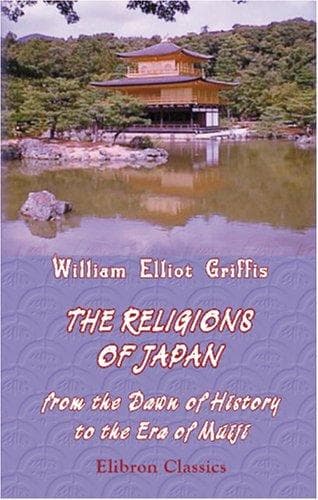
The Religions of Japan, from the Dawn of History to the Era of MéijiGriffis, William Elliot
Religion
The Religions of Japan, from the Dawn of History to the Era of Méiji
Griffis, William Elliot
Japan -- Religion
Not only around the human habitation,[10] but within it, the new
religion brought a marvellous change. Instead of the hut, the
dwelling-house grew to spacious and comfortable proportions, every part
of the Japanese house to-day showing to the cultured student, especially
to one familiar with the ancient poetry, the lines of its origin and
development, and in the larger dwellings expressing a wealth of
suggestion and meaning. The oratory and the kami-dana or shelf holding
the gods, became features in the humblest dwelling. Among the well-to-do
there were of course the gilded ancestral tablets and the worship of
progenitors, in special rooms, with imposing ritual and equipment, with
which Buddhism did not interfere; but on the shelf over the door of
nearly every house in the land, along with the emblems of the kami,
stood images representing the avatars of Buddha.[11] There, the light
ever burned, and there, offerings of food and drink were thrice daily
made. Though the family worship might vary in its length and variety of
ceremony, yet even in the home where no regular system was followed, the
burning lights and the stated offering made, called the mind up to
thoughts higher than the mere level of providing for daily wants. The
visitation of the priests in time of sorrow, or of joy, or for friendly
converse, made religion sweetly human.[12]
Outwardly the Buddhist architecture made a profound change in the
landscape. With a settled religion requiring gorgeous ceremonial, the
chanting of liturgies by large bodies of priests and the formation of
monasteries as centres of literary and religious activity, there were
required stability and permanence in the imperial court itself. While,
therefore, the humble village temples arose all over the country, there
were early erected, in the place where the court and emperor dwelt,
impressive religious edifices.[13] The custom of migration ceased, and a
fixed spot selected as the capital, remained such for a number of
generations, until finally Héian-jō or the place of peace, later
called Kiōto, became the "Blossom Capital" and the Sacred City for a
thousand years. At Nara, where flourished the first six sects introduced
from Korea, were built vast monasteries, temples and images, and thence
the influence of civilisation and art radiated. From the first,
forgetting its primitive democracy and purely moral claims, Buddhism
lusted for power in the State. As early as A.D. 624, various grades were
assigned to the priesthood by the government.[14] The sects eagerly
sought and laid great stress upon imperial favor. To this day they
keenly enjoy the canonization of their great teachers by letters patent
from the Throne.
Ministers of Art.
Public-domain text, read in full here on John Shaqi.
Reviews
Reviews
No reviews yet
Be the first to share your thoughts on this work.
Elsewhere in the archive
Join the Discussion
Join the discussion
Sign in to leave a comment or review.
Sign InorCreate an account