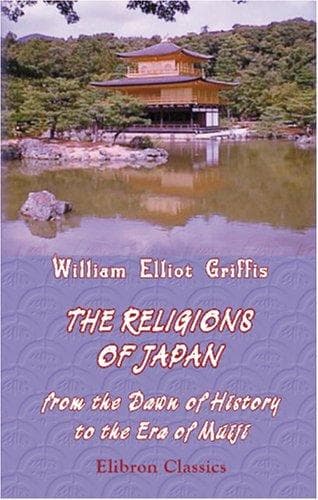
The Religions of Japan, from the Dawn of History to the Era of MéijiGriffis, William Elliot
Religion
The Religions of Japan, from the Dawn of History to the Era of Méiji
Griffis, William Elliot
Japan -- Religion
Along with the blossoming of the lotus in every part of the empire,
bloomed the grander flowers of sculpture, of painting and of temple
architecture. It was because of the carpenter's craft in building
temples that he won his name of Dai-ku, or the great workman. The
artificers of the sunny islands cultivated an ambition, not only to
equal but to excel, their continental brethren of the saw and hammer.
Yet the carpenter was only the leader of great hosts of artisans that
were encouraged, of craftsmen that were educated and of industries that
were called into being by the spread of Buddhism.[15] It was not enough
that village temples and town monasteries should be built, under an
impulse that meant volumes for the development of the country. The
ambitious leaders chose sightly spots on mountains whence were lovely
vistas of scenery, on which to erect temples and monasteries, while it
seemed to be their further ambition to allow no mountain peak to be
inaccessible. With armies of workmen, supported by the contributions of
the faithful who had been aroused to enthusiasm by the preaching of the
bonzes, great swaths were cut in the forest; abundant timber was felled;
rocky plateaus were levelled; and elegant monastic edifices were reared,
soon to be filled with eager students, and young men in training for the
priesthood.
Whether the pilgrimage[16] be of Shintō or of Buddhist origin, or
simply a contrivance of human nature to break the monotony of life, we
need not discuss. It is certain that if the custom be indigenous, the
imported faith adopted, absorbed and enlarged it. The peregrinations
made to the great temples and to the mountain tops, being meritorious
performances, soon filled the roads with more or less devout travellers.
In thus finding vent for their piety, the pilgrims mingled
sanctification with recreation, enjoying healthful holidays, and
creating trade with varied business, commercial and commissarial
activities, while enlarging also their ideas and learning something of
geography. Thus, in the course of time, it has come to pass that Japan
is a country of which almost every square mile is known, while it is
well threaded with paths, banded with roads, and supplied to a
remarkable extent with handy volumes of description and of local
history.[17] Her people being well educated in their own lore and local
traditions, possessed also a voluminous literature of guidebooks and
cyclopedias of information. The devotees were, withal, well instructed
and versed in a code of politeness and courtesy, as pilgrimage and
travel became settled habits of a life. As a further result, the
national tongue became remarkably homogeneous. Broadly speaking, it may
be said that the Japanese language, unlike the Chinese in this as it is
in almost every other point, has very little dialectic variation.[18]
Except in some few remote eddies lying outside the general currents,
there is a uniform national speech. This is largely owing to that annual
Public-domain text, read in full here on John Shaqi.
Reviews
Reviews
No reviews yet
Be the first to share your thoughts on this work.
Elsewhere in the archive
Join the Discussion
Join the discussion
Sign in to leave a comment or review.
Sign InorCreate an account