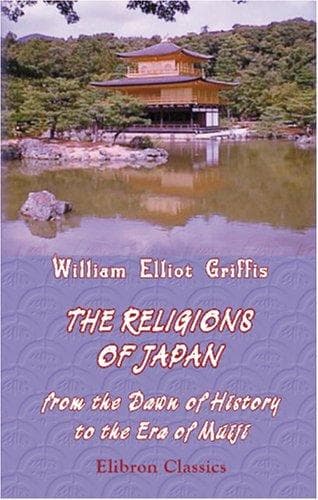
The Religions of Japan, from the Dawn of History to the Era of MéijiGriffis, William Elliot
Religion
The Religions of Japan, from the Dawn of History to the Era of Méiji
Griffis, William Elliot
Japan -- Religion
In every community the inhabitants are enrolled at birth at the
local temple, whose priests are the authorized religious
teachers, and are always expected to take charge of the funerals
of those whose names are thus enrolled. So long as an individual
remains in the region of the family temple, the tie which binds
him to it is exceedingly difficult to break; but if he moves
away he is no longer bound by this tie. This explains the fact,
so often observed by missionaries, that the membership of
Christian churches is made up almost entirely of people who have
come from other localities. In the city of Osaka, for instance,
it is a very rare thing to find a native Osakan in any of the
churches. The same is true in all parts of the country. So long
as a Japanese remains in the neighborhood of his family temple
it is almost impossible to get him to break the temple tie and
join a Christian church; but when he moves to another place he
is free to do as he likes.[36]
This statement of a resident in modern Japan will long remain true for a
large part of the empire.
Political and Military Influences.
A volume might be written and devoted to Japanese Buddhism as a
political power; for, having quickly obtained intellectual possession of
the court and emperor, it dictated the policies of the rulers. In A.D.
624, it was recognized as a state religion, and the hierarchy of priests
was officially established. At this date there were 46 temples and
monasteries, with 816 monks and 569 nuns. As early as the eighth
century, beginning with Shōmu, who reigned A.D. 724-728, and who with
his daughter, afterward the female Mikado, became a disciple of Shaka,
the habit of the emperors becoming monks, shaving their heads and
retiring from public life, came in vogue and lasted until near the
nineteenth century. By this means the bonzes were soon enabled to call
Buddhism "the people's religion," and to secure the resources of the
national treasury as an aid to their temple and monastery building, and
for the erection of those images and wayside shrines on which so many
millions of dollars have been lavished. In addition to this subsidized
propaganda, the Buddhist confessor was too often able, by means of the
wife, concubine, or other female member of the household, imperial or
noble, to dictate the imperial policy in accordance with monkish or
priestly ideas. Ugéno Dō-kiō, a monk, is believed to have aspired
to the throne. Being made premier by the Empress Kō-ken, whose
passion for him is the scandal of history, he made no scruple of
extending the power as well as the influence of the Buddhist hierarchy.
Public-domain text, read in full here on John Shaqi.
Reviews
Reviews
No reviews yet
Be the first to share your thoughts on this work.
Elsewhere in the archive
Join the Discussion
Join the discussion
Sign in to leave a comment or review.
Sign InorCreate an account