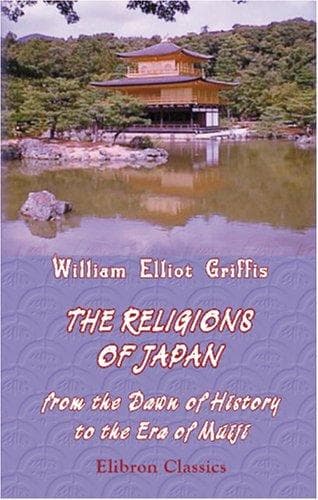
The Religions of Japan, from the Dawn of History to the Era of MéijiGriffis, William Elliot
Religion
The Religions of Japan, from the Dawn of History to the Era of Méiji
Griffis, William Elliot
Japan -- Religion
This time, then, was that of darkest Japan. Yet the people who lived in
darkness saw great light, and to them that dwelt in the shadow of death,
light sprang up.
When Pope Alexander VI. bisected the known world, assigning the western
half, including America to Spain, and the eastern half, including Asia
and its outlying archipelagos to the Portuguese, the latter sailed and
fought their way around Africa to India, and past the golden Chersonese.
In 1542, exactly fifty years after the discovery of America, Dai Nippon
was reached. Mendez Pinto, on a Chinese pirate junk which had been
driven by a storm away from her companions, set foot upon an island
called Tanégashima. This name among the country folks is still
synonymous with guns and pistols, for Pinto introduced fire-arms, and
powder.[3]
During six months spent by the "mendacious" Pinto on the island, the
imitative people made no fewer than six hundred match-locks or
arquebuses. Clearing twelve hundred per cent. on their cargo, the three
Portuguese loaded with presents, returned to China. Their countrymen
quickly flocked to this new market, and soon the beginnings of regular
trade with Portugal were inaugurated. On the other hand, Japanese began
to be found as far west as India. To Malacca, while Francis Xavier was
laboring there, came a refugee Japanese, named Anjiro. The disciple of
Loyola, and this child of the Land of the Rising Sun met. Xavier, ever
restless and ready for a new field, was fired with the idea of
converting Japan. Anjiro, after learning Portuguese and becoming a
Christian, was baptized with the name of Paul. The heroic missionary of
the cross and keys then sailed with his Japanese companion, and in 1549
landed at Kagoshima,[4] the capital of Satsuma. As there was no central
government then existing in Japan, the entrance of the foreigners, both
lay and clerical, was unnoticed.
Having no skill in the learning of languages, and never able to master
one foreign tongue completely, Xavier began work with the aid of an
interpreter. The jealousy of the daimiō, because his rivals had been
supplied with fire-arms by the Portuguese merchants, and the plots and
warnings of those Buddhist priests (who were later crushed by the
Satsuma clansmen as traitors), compelled Xavier to leave this province.
He went first to Hirado,[5] next to Nagatō, and then to Bungo, where
he was well received. Preaching and teaching through his Japanese
interpreter, he formed Christian congregations, especially at
Yamaguchi.[6] Thus, within a year, the great apostle to the Indies had
seen the quick sprouting of the seed which he had planted. His ambition
was now to go to the imperial capital, Kiōto, and there advocate the
claims of Christ, of Mary and of the Pope.
Public-domain text, read in full here on John Shaqi.
Reviews
Reviews
No reviews yet
Be the first to share your thoughts on this work.
Elsewhere in the archive
Join the Discussion
Join the discussion
Sign in to leave a comment or review.
Sign InorCreate an account