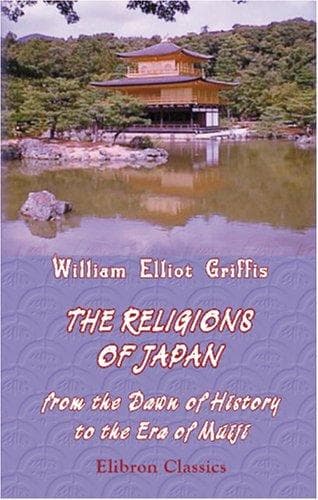
The Religions of Japan, from the Dawn of History to the Era of MéijiGriffis, William Elliot
Religion
The Religions of Japan, from the Dawn of History to the Era of Méiji
Griffis, William Elliot
Japan -- Religion
Such a policy, reminds one of the Amherst agricultural experiment in
which bands of iron were strapped around a much-afflicted squash, in
order to test vital potency. It recalls the pretty little story of
Picciola, in which a tender plant must grow between the interstices of
the bricks in a prison yard. Besides the potent bonds of the only
orthodox Confucian philosophy which was allowed and the legally
recognized religions, there was gradually formed a marvellous system of
legislation, that turned the whole nation into a secret society in which
spies and hypocrites flourished like fungus on a dead log. Besides the
unwritten code of private law,[4] that is, the local and general customs
founded on immemorial usage, there was that peculiar legal system framed
by Iyéyasŭ, bequeathed as a legacy and for over two hundred years
practically the supreme law of the land.
What this law was, it was exceedingly difficult, if not utterly
impossible, for the aliens dwelling in the country at Nagasaki ever to
find out. Keenly intellectual, as many of the physicians,
superintendents and elect members of the Dutch trading company were,
they seem never to have been able to get hold of what has been called
"The Testament of Iyéyasŭ."[5] This consisted of one hundred laws or
regulations, based on a home-spun sort of Confucianism, intended to be
orthodoxy "unbroken for ages eternal."
To a man of western mode of thinking, the most astonishing thing is that
this law was esoteric.[6] The people knew of it only by its irresistible
force, and by the constant pressure or the rare easing of its iron hand.
Those who executed the law were drilled in its routine from childhood,
and this routine became second nature. Only a few copies of the original
instrument were known, and these were kept with a secrecy which to the
people became a sacred mystery guarded by a long avenue of awe.
The Dutchmen at Déshima.
The Dutchmen who lived at Déshima for two centuries and a half, and the
foreigners who first landed at the treaty ports in 1859, on inquiring
about the methods of the Japanese Government, the laws and their
administration, found that everything was veiled behind a vague
embodiment of something which was called "the Law." What that law was,
by whom enacted, and under what sanctions enforced, no one could tell;
though all seemed to stand in awe of it as something of superhuman
efficiency. Its mysteriousness was only equalled by the abject
submission which it received.
Foreign diplomatists, on trying to deal with the seat and source of
authority, instead of seeing the real head of power, played, as it were,
a game of chess against a mysterious hand stretched out from behind a
curtain. Morally, the whole tendency of such a dual system of exclusion
and of inclusion was to make a nation of liars, foster confirmed habits
of deceit, and create a code of politeness vitiated by insincerity.
Public-domain text, read in full here on John Shaqi.
Reviews
Reviews
No reviews yet
Be the first to share your thoughts on this work.
Elsewhere in the archive
Join the Discussion
Join the discussion
Sign in to leave a comment or review.
Sign InorCreate an account