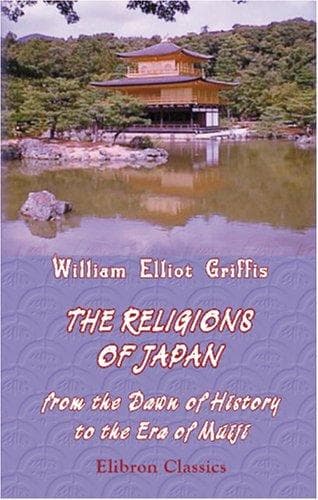
The Religions of Japan, from the Dawn of History to the Era of MéijiGriffis, William Elliot
Religion
The Religions of Japan, from the Dawn of History to the Era of Méiji
Griffis, William Elliot
Japan -- Religion
During the nation's period of Thorn-rose-like seclusion, the three
religions recognized by the law were Buddhism, Shintō and
Confucianism. Christianity was the outlawed sect. All over the country,
on the high-roads, at the bridges, and in the villages, towns and
cities, the fundamental laws of the country were written on wooden
tablets called kosatsŭ. These, framed and roofed for protection from
the weather, but easily before the eyes of every man, woman and child,
and written in a style and language understood of all, denounced the
Christian religion as an accursed "sect," and offered gold to the spy
and informer;[19] while once a year every Samurai was required to swear
on the true faith of a gentleman that he had nothing to do with
Christianity. From the seventeenth century, the country having been
divided into parishes, the inquisition was under the charge of the
Buddhist priests who penetrated into the house and family and guarded
the graveyards, so that neither earth nor fire should embrace the
carcass of a Christian, nor his dust or ashes defile the ancestral
graveyards. Twice--in 1686 and in 1711--were the rewards increased and
the Buddhist bloodhounds of Japan's Inquisition set on fresh trails. On
one occasion, at Osaka, in 1839,[20] a rebellion broke out which was
believed, though without evidence, to have been instigated in some way
by men with Christian ideas, and was certainly led by Oshio, the bitter
opponent of Buddhism, of Tokugawa, and of the prevalent Confucianism.
Possibly, the uprising was aided by refugees from Korea. Those
implicated were, after speedy trial, crucified or beheaded. In the
southern part of the country the ceremony of Ebumi or trampling on the
cross,[21] was long performed. Thousands of people were made to pass
through a wicket, beneath which and on the ground lay a copper plate
engraved with the image of the Christ and the cross. In this way it was
hoped to utterly eradicate the very memory of Christianity, which, to
the common people, had become the synonym for sorcery.
But besides the seeking after God by earnest souls and the protest of
philosophers, there was, amid the prevailing immorality and the
agnosticism and scepticism bred by decayed Buddhism and the
materialistic philosophy based on Confucius, some earnest struggles for
the purification of morals and the spiritual improvement of the people.
The Shingaku Movement.
Public-domain text, read in full here on John Shaqi.
Reviews
Reviews
No reviews yet
Be the first to share your thoughts on this work.
Elsewhere in the archive
Join the Discussion
Join the discussion
Sign in to leave a comment or review.
Sign InorCreate an account