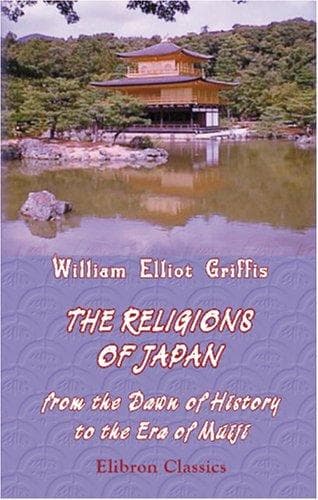
The Religions of Japan, from the Dawn of History to the Era of MéijiGriffis, William Elliot
Religion
The Religions of Japan, from the Dawn of History to the Era of Méiji
Griffis, William Elliot
Japan -- Religion
The purpose of these envoys was, first of all, to ask of the nations of
Christendom equal rights, to get removed the odious extra-territoriality
clause in the treaties, to have the right to govern aliens on their
soil, and to regulate their own tariff. Secondarily, its members
went to study the secrets of power and the resources of civilization in
the West, to initiate the liberal education of their women by leaving in
American schools a little company of maidens, to enlarge the system of
education for their own country, and to send abroad with approval others
of their young men who, for a decade past had, in spite of every ban and
obstacle, been furtively leaving the country for study beyond the seas.
In the lands of Christendom, the eyes of ambassadors, ministers,
secretaries and students were opened. They saw themselves as others saw
them. They compared their own land and nation, mediaeval in spirit and
backward in resources, and their people untrained as children, with the
modern power, the restless ambition, the stern purpose, the intense life
of the western nations, with their mighty fleets and armaments, their
inventions and machinery, their economic and social theories and forces,
their provision for the poor, the sick, and the aged, the peerless
family life in the Christian home. They found, further yet, free
churches divorced from politics and independent of the state; that the
leading force of the world was Christianity, that persecution was
barbarous, and that toleration was the law of the future, and largely
the condition of the present. It took but a few whispers over the
telegraphic wire, and the anti-Christian edicts disappeared from public
view like snowflakes melting on the river. The right arm of persecution
was broken.
The story of the Book of Acts of the modern apostles in Japan is told,
first in the teaching of inquirers, preaching to handfuls, the gathering
of tiny companies, the translation of the Gospel, and then prayer and
waiting for the descent of the Holy Spirit. A study of the Book of the
Acts of the Apostles, followed in order to find out how the Christian
Church began. On the 10th day of March, in the year of our Lord and of
the era of Meiji (Enlightened Peace) the fifth, 1872, at Yokohama, in
the little stone chapel built on part of Commodore Perry's treaty
ground, was formed the first Reformed or Protestant Christian Church in
Japan.
At this point our task is ended. We cannot even glance at the native
Christian churches of the Roman, Reformed, or Greek order, or attempt to
appraise the work of the foreign missionaries. He has read these pages
in vain, however, who does not see how well, under Providence, the
Japanese have been trained for higher forms of faith.
Public-domain text, read in full here on John Shaqi.
Reviews
Reviews
No reviews yet
Be the first to share your thoughts on this work.
Elsewhere in the archive
Join the Discussion
Join the discussion
Sign in to leave a comment or review.
Sign InorCreate an account