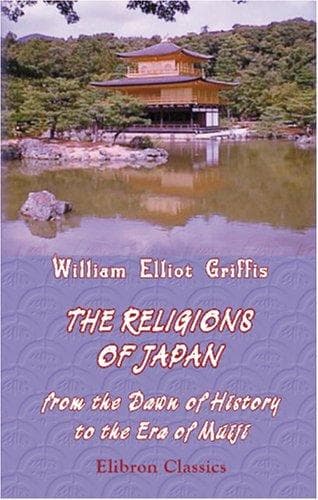
The Religions of Japan, from the Dawn of History to the Era of MéijiGriffis, William Elliot
Religion
The Religions of Japan, from the Dawn of History to the Era of Méiji
Griffis, William Elliot
Japan -- Religion
next brought in from the Mikado's stable, and all the congregation drew
near, while the reader recited or read the norito. This reader was a
member of the priestly family or tribe of Nakatomi, who traced their
descent back to Ameno-koyané, one of the principal advisers attached to
the sun-goddess's grandchild when he first descended on earth. It is a
remarkable evidence of the persistence of certain ideas, that up to the
year 1868 the nominal prime-minister of the Mikado, after he came of
age, and the regent during his minority, if he had succeeded young to
the throne, always belonged to this tribe, which changed its name from
Nakatomi to Fujiwara in the seventh century, and was subsequently split
up into the Five Setsuké or governing families. At the end of each
section the priests all responded 'O!' which was no doubt the equivalent
of 'Yes' in use in those days. As soon as he had finished, the Nakatomi
retired, and the offerings were distributed to the priests for
conveyance and presentation to the gods to whose service they were
attached. But a special messenger was despatched with the offerings
destined to the temples at Watarai. This formality having been
completed, the President of the Jin-Gi-Kuan gave the signal for breaking
up the assembly." Ancient Japanese Rituals, T.A.S.J., Vol. VII, pp.
104-107.]
[Footnote 12: S. and H., p. 461.]
[Footnote 13: Consult Chamberlain's literal translations of the name in
the Kojiki, and p. lxv. of his Introduction.]
[Footnote 14: The parallel between the Hebrew and Japanese accounts of
light and darkness, day and night, before the sun, has been noticed by
several writers. See the comments of Hirata, a modern Shintō
expounder.--T.A.S.J., Vol. III., Appendix, p. 72.]
[Footnote 15: Westminster Review, July, 1878, p. 19.]
CHAPTER III
"THE KOJIKI" AND ITS TEACHINGS
[Footnote 1: Kojiki, pp. 9-18; T.A.S.J., Vol. III., Appendix, p. 20.]
[Footnote 2: M.E., p. 43; McClintock and Strong's Cyclopedia, Art.
Shintō; in T.A.S.J., Vol. III., Appendix, is to be found Mr. Satow's
digest of the commentaries of the modern Shintō revivalists; in Mr.
Chamberlain's translation of the Kojiki, the text with abundant notes.
See also Mr. Twan-Lin's Account of Japan up to A.D. 1200, by E.H.
Parker. T.A.S.J., Vol. XXII., Part I.]
[Footnote 3: "The various abstractions which figure at the commencement
of the 'Records' (Kojiki) and of the 'Chronicles' (Nihongi) were
probably later growths, and perhaps indeed were inventions of individual
priests."--Kojiki, Introd., p. lxv. See also T.A.S.J., Vol. XXII., Part
I, p. 56. "Thus, not only is this part of the Kojiki pure twaddle, but
it is not even consistent twaddle."]
[Footnote 4: Kojiki, Section IX.]
Public-domain text, read in full here on John Shaqi.
Reviews
Reviews
No reviews yet
Be the first to share your thoughts on this work.
Elsewhere in the archive
Join the Discussion
Join the discussion
Sign in to leave a comment or review.
Sign InorCreate an account