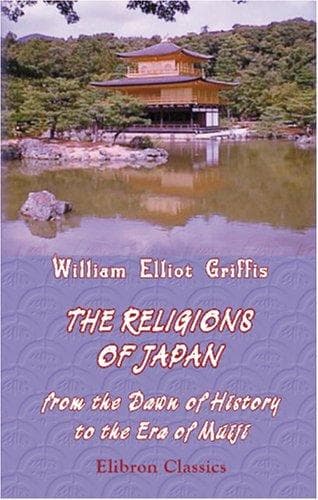
The Religions of Japan, from the Dawn of History to the Era of MéijiGriffis, William Elliot
Religion
The Religions of Japan, from the Dawn of History to the Era of Méiji
Griffis, William Elliot
Japan -- Religion
[Footnote 22: The Shell Mounds of Omori; and The Tokio Times, Jan. 18,
1879, by Edward S. Morse; Japanese Fairy World, pp. I78, 191, 196.]
[Footnote 23: Kojiki, pp. 60-63.]
[Footnote 24: S. and H., pp. 58, 337, etc.]
[Footnote 25: This study in comparative religion by a Japanese, which
cost the learned author his professorship in the Téi-Koku Dai Gaku or
Imperial University (lit. Theocratic Country Great Learning Place), has
had a tendency to chill the ardor of native investigators. His paper was
first published in the Historical Magazine of the University, but the
wide publicity and popular excitement followed only after republication,
with comments by Mr. Taguchi, in the Kéizai Zasshi (Economical Journal).
The Shintōists denounced Professor Kumi for "making our ancient
religion a branch of Christianity," and demanded and secured his
"retirement" by the Government. See Japan Mail, April 2, 1892, p. 440.]
[Footnote 26: T.A.S.J., Vol. XXI., p. 282.]
[Footnote 27: Kojiki, p. xxviii.]
[Footnote 28: For the use of salt in modern "Esoteric" Shintō, both
in purification and for employment as of salamandrine, see T.A.S.J., pp.
125, 128.]
[Footnote 29: In the official census of 1893, nine Shintō sects are
named, each of which has its own Kwancho or Presiding Head, recognized
by the government. The sectarian peculiarities of Shintō have been
made the subject of study by very few foreigners. Mr. Satow names the
following:
The Yui-itsu sect was founded by Toshida Kané-tomo. His signature
appears as the end of a ten-volume edition, issued A.D. 1503, of the
liturgies extracted from the Yengishiki or Book of Ceremonial Law, first
published in the era of Yengi (or En-gi), A.D. 901-922. He is supposed
to be the one who added the _kana_, or common vernacular script letters,
to the Chinese text and thus made the norito accessible to the people.
The little pocket prayer-books, folded in an accordeon-like manner, are
very cheap and popular. The sect is regarded as heretical by strict
Shintōists, as the system Yuwiitsu consists "mainly of a Buddhist
superstructure on a Shintō foundation." Yoshida applied the tenets of
the Shingon or True Word sect of Buddhists to the understanding and
practice of the ancient god-way.
The Suiga sect teaches a system which is a combination of Yuwiitsu and
of the modern philosophical form of Confucianism as elaborated by Chu
Hi, and known in Japan as the Téi-shu philosophy. The founder was
Yamazaki Ansai, who was born in 1618 and died in 1682. By combining the
forms of the Yoshida sect, which is based on the Buddhism of the Shingon
sect, with the materialistic philosophy of Chu Hi, he adapted the old
god-way to what he deemed modern needs.
Public-domain text, read in full here on John Shaqi.
Reviews
Reviews
No reviews yet
Be the first to share your thoughts on this work.
Elsewhere in the archive
Join the Discussion
Join the discussion
Sign in to leave a comment or review.
Sign InorCreate an account