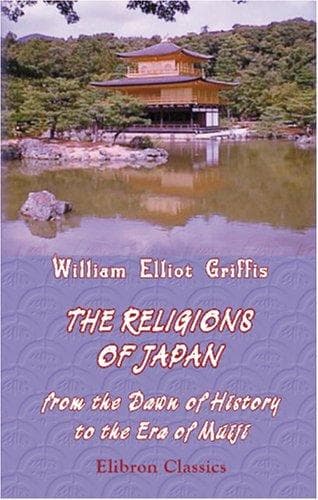
The Religions of Japan, from the Dawn of History to the Era of MéijiGriffis, William Elliot
Religion
The Religions of Japan, from the Dawn of History to the Era of Méiji
Griffis, William Elliot
Japan -- Religion
"_Amitábha_ is the fourth _Dhyani_ or celestial _Budda: Padma-pani_ his
_Æon_ and executive minister. _Padma-pani_ is the _praesens Divus_ and
creator of the _existing_ system of worlds. Hence his identification
with the third member of the _Triad_. He is figured as a graceful youth,
erect, and bearing in either hand a _lotos_ and a jewel. The last
circumstance explains the meaning of the celebrated _Shadakshári
Mantra_, or six-lettered invocation of him, viz., _Om! Manipadme hom!_
of which so many corrupt versions and more corrupt interpretations have
appeared from Chinese, Tibetan, Mongolian, and other sources. The
_mantra_ in question is one of three, addressed to the several members
of the _Triad_. 1. _Om sarva vidye hom_. 2. _Om Prajnáye hom_. 3. _Om
mani-padme hom_. 1. The mystic triform Deity is in the all-wise
(Buddha). 2. The mystic triform Deity is in Prajna (Dharma). 3. The
mystic triform Deity is in him of the jewel and lotos (Sangha). But the
praesens Divus, whether he be Augustus or _Padma-pani_, is everything
with the many. Hence the notoriety of this _mantra_, whilst the others
are hardly ever heard of, and have thus remained unknown to our
travellers."--The Phoenix, Vol. II., p. 64.]
[Footnote 28: "Nine centuries after Buddha, Maitreya (Miroku or Ji-shi)
came down from the Tushita heaven to the lecture-hall in the kingdom of
Ayodhya (A-ya-sha) in Central India, at the request of the Bodhisattva
Asamga (Mu-jaku) and discoursed five Sastras, 1, Yoga-karya-bhumi-sastra
(Yu-ga-shi-ji-ron), etc.... After that, the two great Sastra teachers,
Asanga and Vasubandhu (Se-shin), who were brothers, composed many
Sastras (Ron) and cleared up the meaning of the Mahayana" (or Greater
Vehicle, canon of Northern Buddhism).--B.N., p. 32.]
[Footnote 29: Buddhism, T. Rhys Davids, pp. 206-211.]
[Footnote 30: Prayer-wheels in Japan are used by the Tendai and Shingon
sects, but without written prayers attached, and rather as an
illustration of the doctrine of cause and effect (ingwa); the prayers
being usually offered to Jizo the merciful.--S. and H., p. 29; T. J., p.
360.]
[Footnote 31: For this see Edkins's Chinese Buddhism; Eitel's Three
Lectures, and Hand-book; Rev. S. Beal's Buddhism, and A Catena of
Buddhist Scriptures from the Chinese; The Romantic Legend of Sakya
Buddha, from the Chinese; Texts from the Buddhist canon commonly known
as the Dhammapeda; Notes on Buddhist Words and Phrases, the
Chrysanthemum, Vol. I.; The Phoenix, Vols. I-III.
See, also, a spirited sketch of Ancient Japan, by Frederick Victor
Dickins, in the Life of Sir Harry Parkes, Vol. II., pp. 4-14.]
[Footnote 32: S. and H., pp. 289, 293; Chamberlain's Hand-book for
Japan, p. 220; Summer's Notes on Osaka, T.A.S.J., Vol. VIL, p. 382;
Buddhism, and Traditions Concerning its Introduction into Japan,
T.A.S.J., Vol. XIV., p. 78.]
[Footnote 33: S. and H., p. 344.]
[Footnote 34: T.J., p. 73.]
Public-domain text, read in full here on John Shaqi.
Reviews
Reviews
No reviews yet
Be the first to share your thoughts on this work.
Elsewhere in the archive
Join the Discussion
Join the discussion
Sign in to leave a comment or review.
Sign InorCreate an account