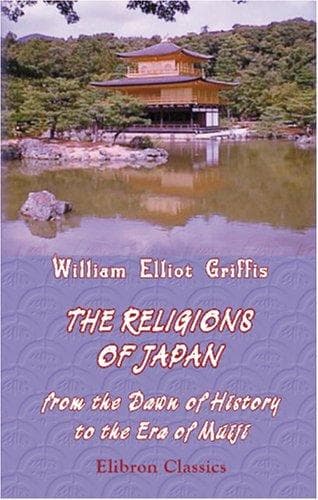
The Religions of Japan, from the Dawn of History to the Era of MéijiGriffis, William Elliot
Religion
The Religions of Japan, from the Dawn of History to the Era of Méiji
Griffis, William Elliot
Japan -- Religion
"Love and enjoyment disappear,
What in our world endureth here?
E'en should this day it oblivion be rolled,
'Twas only a vision that leaves me cold."
]
[Footnote 15: This legend suggests the mediaeval Jewish story, that
Ezra, the scribe, could write with five pens at once; Hearn's Glimpses
of Unfamiliar Japan, pp. 29-33.]
[Footnote 16: Brave Little Holland, and What She Taught Us, p. 124.]
[Footnote 17: T.J., pp. 75, 342; Chamberlain's Hand-book for Japan, p.
41; M.E., p. 162.]
[Footnote 18: T.A.S.J., Vol. II., p. 101; S. and H., p. 176.]
[Footnote 19: It was for lifting with his walking-stick the curtain
hanging before the shrine of this Kami that Arinori Mori, formerly
H.I.J.M. Minister at Washington and London, was assassinated by a
Shintō fanatic, February 11, 1889; T. J., p. 229; see Percival
Lowell's paper in the Atlantic Monthly.]
[Footnote 20: See Mr. P. Lowell's Esoteric Shintō, T.A.S.J., Vol.
XXI, pp. 165-167, and his "Occult Japan."]
[Footnote 21: S. and H., Japan, p. 83.]
[Footnote 22: See the Author's Introduction to the Arabian Nights'
Entertainments, Boston, 1891.]
[Footnote 23: B.N., Index and pp. 78-103; Edkins's Chinese Buddhism, p.
169.]
[Footnote 24: Satow's or Chamberlain's Guide-books furnish hundreds of
other instances, and describe temples in which the renamed kami are
worshipped.]
[Footnote 25: S. and H., p. 70.]
[Footnote 26: M.E., pp. 187, 188; S. and H., pp. 11, 12.]
[Footnote 27: San Kai Ri (Mountain, Sea, and Land). This work,
recommended to me by a learned Buddhist priest in Fukui, I had
translated and read to me by a Buddhist of the Shin Shu sect. In like
manner, even Christian writers in Japan have occasionally endeavored to
rationalize the legends of Shintō, see Kojiki, p. liii., where Mr. T.
Goro's Shintō Shin-ron is referred to. I have to thank my friend Mr.
C. Watanabé, of Cornell University, for reading to me Mr. Takahashi's
interesting but unconvincing monographs on Shintō and Buddhism.]
[Footnote 28: T.J., p. 402; Some Chinese Ghosts, by Lafcadio Hearn, p.
129.]
[Footnote 29: S. and H., Japan, p. 397; Classical Poetry of the
Japanese, p. 201, note.]
[Footnote 30: The Japanese word Ryō means both, and is applied to the
eyes, ears, feet, things correspondent or in pairs, etc.; _bu_ is a term
for a set, kind, group, etc.]
[Footnote 31: Rein, p. 432; T.A.S.J., Vol. XXI., pp. 241-270; T.J., p.
339.]
[Footnote 32: The Chrysanthemum, Vol. I., p. 401.]
[Footnote 33: Even the Takétori Monogatari (The Bamboo Cutter's
Daughter), the oldest and the best of the Japanese classic romances is
(at least in the text and form now extant) a warp of native ideas with a
woof of Buddhist notions.]
[Footnote 34: Mr. Percival Lowell argues, in Esoteric Shintō,
T.A.S.J., Vol. XXI., that besides the habit of pilgrimages,
fire-walking, and god-possession, other practices supposed to be
Buddhistic are of Shintō origin.]
Public-domain text, read in full here on John Shaqi.
Reviews
Reviews
No reviews yet
Be the first to share your thoughts on this work.
Elsewhere in the archive
Join the Discussion
Join the discussion
Sign in to leave a comment or review.
Sign InorCreate an account