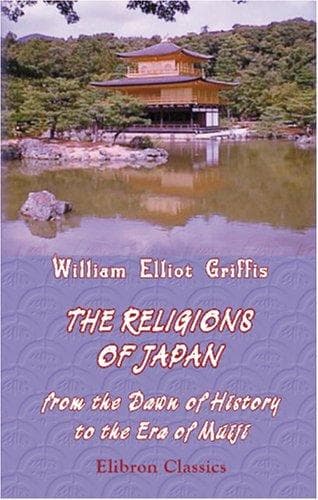
The Religions of Japan, from the Dawn of History to the Era of MéijiGriffis, William Elliot
Religion
The Religions of Japan, from the Dawn of History to the Era of Méiji
Griffis, William Elliot
Japan -- Religion
For nearly twenty years this deliverance of the Japanese Government,
which still finds its strongest support in the national traditions and
the reverence of the people for the throne, sufficed for the necessities
of the case. Then the copious infusion of foreign ideas, the
disintegration of the old framework of society, and the weakening of the
old ties of obedience and loyalty, with the flood of shallow knowledge
and education which gave especially children and young people just
enough of foreign ideas to make them dangerous, brought about a
condition of affairs which alarmed the conservative and patriotic. Like
fungus upon a dead tree strange growths had appeared, among others that
of a class of violently patriotic and half-educated young men and boys,
called _Soshí_. These hot-headed youths took it upon themselves to
dictate national policy to cabinet ministers, and to reconstruct
society, religion and politics. Something like a mania broke out all
over the country which, in certain respects, reminds us of the
Children's Crusade, that once afflicted Europe and the children
themselves. Even Christianity did not escape the craze for
reconstruction. Some of the young believers and pupils of the
missionaries seemed determined to make Christianity all over so as to
suit themselves. This phase of brain-swelling is not yet wholly over.
One could not tell but that something like the Tai Ping rebellion, which
disturbed and devastated China, might break out.
These portentous signs on the social horizon called forth, in 1892, from
the government an Imperial Rescript, which required that the emperor's
photograph be exhibited in every school, and saluted by all teachers and
scholars whatever their religious tenets and scruples might be. Most
Christians as well as Buddhists, saw nothing in this at which to
scruple. A few, however, finding in it an offence to conscience,
resigned their positions. They considered the mandate an unwarrantable
interference with their rights as conferred by the constitution of 1889,
which in theory is the gift of the emperor to his people.
The radical Shintōist, to this day, believes that all political
rights which Japanese enjoy or can enjoy are by virtue of the Mikado's
grace and benevolence. It is certain that all Japanese, whatever may be
their religious convictions, consider that the constitution depends for
its safeguards and its validity largely upon the oath which the Mikado
swore at the shrine of his heavenly ancestors, that he would himself be
obedient to it and preserve its provisions inviolate. For this solemn
ceremony a special norito or liturgy was composed and recited.
Summary of Shintō.
Public-domain text, read in full here on John Shaqi.
Reviews
Reviews
No reviews yet
Be the first to share your thoughts on this work.
Join the Discussion
Join the discussion
Sign in to leave a comment or review.
Sign InorCreate an account