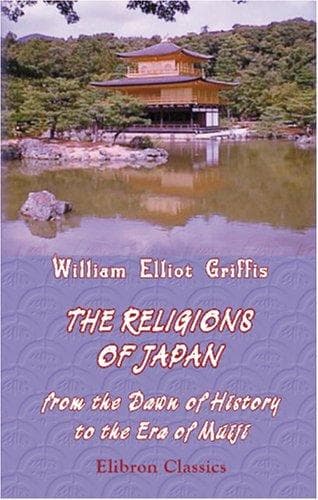
The Religions of Japan, from the Dawn of History to the Era of MéijiGriffis, William Elliot
Religion
The Religions of Japan, from the Dawn of History to the Era of Méiji
Griffis, William Elliot
Japan -- Religion
In 1870, with the Shōgun of Yedo deposed, the dual system abolished,
feudalism in its last gasp and Shintō in full political power, with
the ancient council of the gods (Jin Gi Kuan) once more established, and
purified Shintō again the religion of state, thousands of Riyōbu
Shintō temples were at once purged of all their Buddhist ornaments,
furniture, ritual, and everything that might remind the Japanese of
foreign elements. Then began, logically and actually, the persecution of
those Christians, who through all the centuries of repression and
prohibition had continued their existence, and kept their faith however
mixed and clouded. Theoretically, ancient belief was re-established, yet
it was both physically and morally impossible to return wholly to the
baldness and austere simplicity of those early ages, in which art and
literature were unknown. For a while it seemed as though the miracle
would be performed, of turning back the dial of the ages and of plunging
Japan into the fountain of her own youth. Propaganda was instituted, and
the attempts made to convert all the Japanese to Shintō tenets and
practice were for a while more lively than edifying; but the scheme was
on the whole a splendid failure, and bitter disappointment succeeded the
first exultation of victory. Confronted by modern problems of society
and government, the Mikado's ministers found themselves unable, if
indeed willing, to entomb politics in religion, as in the ancient ages.
For a little while, in 1868, the Jin Gi Kuan, or Council of the Gods of
Heaven and Earth, held equal authority with the Dai Jō Kuan, or Great
Council of the Government. Pretty soon the first step downward was
taken, and from a supreme council it was made one of the ten departments
of the government. In less than a year followed another retrograde
movement and the department was called a board. Finally, in 1877, the
board became a bureau. Now, it is hard to tell what rank the Shintō
cultus occupies in the government, except as a system of guardianship
over the imperial tombs, a mode of official etiquette, and as one of the
acknowledged religions of the country.
Nevertheless, as an element in that amalgam of religions which forms the
creed of most Japanese, Shintō is a living force, and shares with
Buddhism the arena against advancing Christianity, still supplying much
of the spring and motive to patriotism.
The Shintō lecturers with unblushing plagiarism rifled the
storehouses of Chinese ethics. They enforced their lessons from the
Confucian classics. Indeed, most of their homiletical and illustrative
material is still derived directly therefrom. Their three main official
theses and commandments were:
1. Thou shalt honor the Gods and love thy country.
2. Thou shalt clearly understand the principles of Heaven, and
the duty of man.
3. Thou shalt revere the Emperor as thy sovereign and obey the
will of his Court.
Public-domain text, read in full here on John Shaqi.
Reviews
Reviews
No reviews yet
Be the first to share your thoughts on this work.
Join the Discussion
Join the discussion
Sign in to leave a comment or review.
Sign InorCreate an account