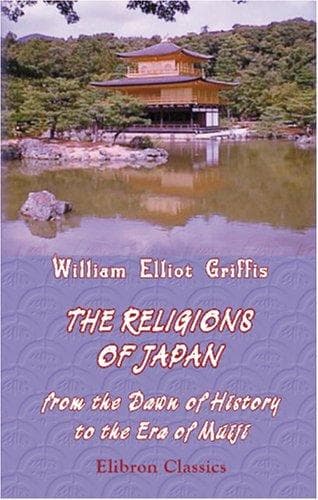
The Religions of Japan, from the Dawn of History to the Era of MéijiGriffis, William Elliot
Religion
The Religions of Japan, from the Dawn of History to the Era of Méiji
Griffis, William Elliot
Japan -- Religion
The common Japanese novels read like records of slaughter-houses. No
Moloch or Shiva has won more victims to his shrine than has this idea of
Japanese loyalty which is so beautiful in theory and so hideous in
practice. Despite the military clamps and frightful despotism of Yedo,
which for two hundred and fifty years gave to the world a delusive idea
of profound quiet in the Country of Peaceful Shores, there was in fact a
chronic unrest which amounted at many times and in many places to
anarchy. The calm of despotism was, indeed, rudely broken by the aliens
in the "black ships" with the "flowery flag"; but, without regarding
influences from the West, the indications of history as now read,
pointed in 1850 toward the bloodiest of Japan's many civil wars. Could
the statistics of the suicides during this long period be collected,
their publication would excite in Christendom the utmost incredulity.
Nevertheless, this qualifying statement should be made. A study of the
origin and development of the national method of self-destruction shows
that suicide by seppuku, or opening of the abdomen, was first a custom,
and then a privilege. It took, among men of honor, the place of the
public executions, the massacres in battle and siege, decimation of
rebels and similar means of killing at the hands of others, which so
often mar the historical records of western nations. Undoubtedly,
therefore, in the minds of most Japanese, there are many instances of
_hara-kiri_ which should not be classed as suicide, but technically as
execution of judicial sentence. And yet no sentence or process of death
known in western lands had such influence in glorifying the victim, as
had seppuku in Japan.
The Family Idea.
The Second Relation is that of father and son, thus preceding what we
should suppose to be the first of human relations--husband and wife--but
the arrangement entirely accords with the Oriental conception that the
family, the house, is more important than the individual. In Old Japan
the paramount idea in marriage, was not that of love or companionship,
or of mutual assistance with children, but was almost wholly that of
offspring, and of maintaining the family line.[20] The individual might
perish but the house must live on.
Public-domain text, read in full here on John Shaqi.
Reviews
Reviews
No reviews yet
Be the first to share your thoughts on this work.
Elsewhere in the archive
Join the Discussion
Join the discussion
Sign in to leave a comment or review.
Sign InorCreate an account