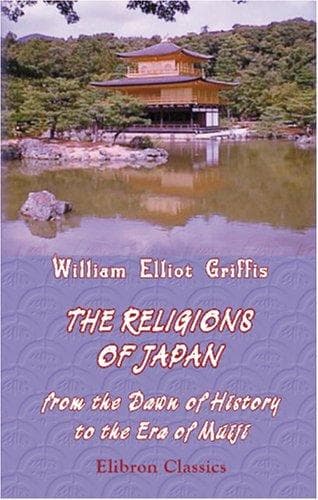
The Religions of Japan, from the Dawn of History to the Era of MéijiGriffis, William Elliot
Religion
The Religions of Japan, from the Dawn of History to the Era of Méiji
Griffis, William Elliot
Japan -- Religion
already held sway over the intellect of China. For two centuries and a
half it has dominated the minds of the Samurai so that the majority of
them to-day, even with the new name Shizoku, are Confucianists so far as
they are anything.
To understand the origin of Buddhism we must know something of the
history and the previous religious and philosophical systems of India,
and so, if we are to appreciate modern "orthodox" Confucianism, we must
review the history of China, and see, in outline, at least, its
literature, politics and philosophy during the middle ages.
"Four great stages of literary and national development may be pointed
to as intervening (in the fifteen hundred years) between the great sage
and the age called that of the Sung-Ju,"[3] from the tenth to the
fourteenth century, in which the Confucian system received its modern
form. Each of them embraced the course of three or four centuries.
I. From the sixth to the third century before Christ the struggle was
for Confucian and orthodox doctrine, led by Mencius against various
speculators in morals and politics, with Taoist doctrine continually
increasing in acceptance.
II. The Han age (from B.C. 206 to A.D. 190) was rich in critical
expositors and commentators of the classics, but "the tone of
speculation was predominantly Taoist."
III. The period of the Six Dynasties (from A.D. 221 to A.D. 618) was the
golden age of Buddhism, when the science and philosophy of India
enriched the Chinese mind, and the wealth of the country was lavished on
Buddhist temples and monasteries. The faith of Shaka became nearly
universal and the Buddhists led in philosophy and literature, founding a
native school of Indian philosophy.
IV. The Tang period (from A.D. 618 to 905) marked by luxury and poetry,
was an age of mental inaction and enervating prosperity.
V. The fifth epoch, beginning with the Sung Dynasty (from A.D. 960 to
1333) and lasting to our own time, was ushered in by a period of intense
mental energy. Strange to say (and most interesting is the fact to
Americans of this generation), the immediate occasion of the recension
and expansion of the old Confucianism was a Populist movement.[4] During
the Tang era of national prosperity, Chinese socialists questioned the
foundations of society and of government, and there grew up a new school
of interpreters as well as of politicians. In the tenth century the
contest between the old Confucianism and the new notions, broke out with
a violence that threatened anarchy to the whole empire.
One set of politicians, led by Wang (1021-1086), urged an extension of
administrative functions, including agricultural loans, while the
brothers Cheng (1032-1085, 1033-1107) reaffirmed, with fresh
intellectual power, the old orthodoxy.
Public-domain text, read in full here on John Shaqi.
Reviews
Reviews
No reviews yet
Be the first to share your thoughts on this work.
Elsewhere in the archive
Join the Discussion
Join the discussion
Sign in to leave a comment or review.
Sign InorCreate an account