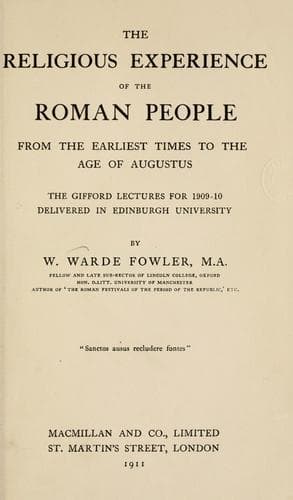
The Religious Experience of the Roman People: From the Earliest Times to the Age of AugustusFowler, W. Warde (William Warde)
Religion
The Religious Experience of the Roman People: From the Earliest Times to the Age of Augustus
Fowler, W. Warde (William Warde)
Cults -- Rome; Rome -- Religion
What did the old Romans know about the nature of the objects of their
worship? All religion is in its development a process of gaining such
knowledge: if it makes no progress it is doomed. It is because the Jews
made such wonderful progress in this path, in spite of formalism and
backsliding, that they were chosen to produce a Teacher whose life and
doctrine revealed the will and the nature of His Father for the eternal
benefit of mankind. The fear of the Lord is imperfect knowledge, it is
but the beginning of wisdom; but it could become, in a Jew like St.
Paul, the perfect knowledge of His will. It may seem absurd to think of
two such religions as the Jewish and the Roman side by side; but the
absurdity vanishes when we begin to understand the humble beginnings of
the Jewish religion as scientific research has already laid it bare.
Knowledge of the Power manifesting itself in the universe is open to all
peoples alike, and some few have made much progress in it beside the
Jews. The Romans were not among these, at any rate in all the later
stages of their history; but we have to ask how far they got in the
process, and later on again to ask also why they could go no
farther.[220]
We have seen how one great forward step in the attainment of this
knowledge was made in the religion of the household, when the house had
become a kind of temple, being the dwelling of divine as well as human
beings, and when the cultivated land had been separated by a sacred
boundary from the mountain or forest beyond, with their wild and unknown
spiritual inhabitants. We met, however, with nothing in the house or on
the land that we can properly call a god, if we may use that word for
the moment in the sense of a personality as well as a name, and a
personality perfectly distinct from the object in which it resides.
Vesta seems to be the fire, Penates the store, or at least spirits
undistinguishable from the substance composing the store. But inasmuch
as the farmer knew how to serve these spirits and address them, looking
upon them as friends and co-habitants of his own dwelling, we may go so
far as to guess that they were somewhat advanced in their career as
spirits, and might possibly develop into powers of a more definite kind,
if not into gods, real _dei_ conceived as persons.[221] In other
words--for it is better to keep as far as we can to the subjective or
psychological aspect of them--the Roman might realise the Power better
by getting to think of his nameless spirits as _dei_ at work for his
benefit if rightly propitiated. There are some signs in the calendar and
the other sources I mentioned just now that such a process had been
going on before the State arose; and it is certain that the whole field
of divine operation had been greatly widened by that time, as we might
expect from the enlarged sphere of man's experience and activity.
Public-domain text, read in full here on John Shaqi.
Reviews
Reviews
No reviews yet
Be the first to share your thoughts on this work.
Elsewhere in the archive
Join the Discussion
Join the discussion
Sign in to leave a comment or review.
Sign InorCreate an account