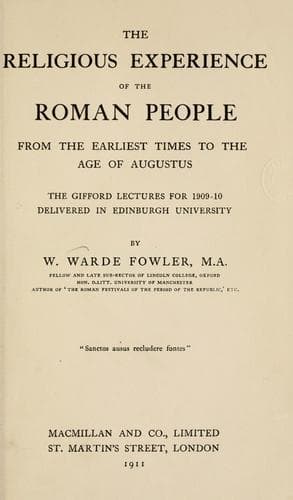
The Religious Experience of the Roman People: From the Earliest Times to the Age of AugustusFowler, W. Warde (William Warde)
Religion
The Religious Experience of the Roman People: From the Earliest Times to the Age of Augustus
Fowler, W. Warde (William Warde)
Cults -- Rome; Rome -- Religion
[265] There are distinct traces of a practice of taking
oaths in the open air, _i.e._ under the sky; of Dius
Fidius, unquestionably a form of Jupiter, Varro says
(_L.L._ v. 66), "quidam negant sub tecto per hunc
deiurare oportere." Cp. Plutarch, _Quaest. Rom._ 28;
_R.F._ p. 138. For the conception of a single great
deity as primitive, see Lang, _The Making of Religion_,
ch. xii.; Flinders Petrie, _Religion of Egypt_ (in
Constable's shilling series), ch. i.; Ross, _The
Original Religion of China_, p. 128 foll.; Warneck, _Die
Lebenskraefte des Evangeliums_, p. 20 (of the Indian
Archipelago). The last reference I owe to Professor
Paterson, of Edinburgh University.
[266] Serv. _Aen._ viii. 552, "more enim veteri sacrorum
neque Martialis flamen neque Quirinalis omnibus
caerimoniis tenebantur quibus flamen Dialis, neque
diurnis sacrificiis distinebatur." It is, however,
possible that under the word _caerimonia_ Servius is not
here including taboos, but active duties only.
[267] See my paper, "The Strange History of a Flamen
Dialis," in _Classical Review_, vol. vii. p. 193.
[268] Henzen, _Acta Fratr. Arv._ p. 26.
[269] Cato, _R.R._ 141; Henzen, _op. cit._ p. 48.
[270] Frazer, _G.B._ iii. 123, note 3; _R.F._ p. 40, for
further examples. It may be worth while to point out
here that the coupling of all farm animals except goats
took place in spring or early summer; Varro, _R.R._ ii.
2 foll. Isidorus (_Orig._ v. 33), who embodies Varro and
Verrius to some extent, derived the name Mars from
_mares_, because in the month of March "cuncta animalia
ad mares aguntur."
[271] I prefer, with De Marchi, to take Silvanus here as
a cult-title, though we do not meet with it elsewhere;
see _La Religione_, _etc._, p. 130 note; but Wissowa,
who has a prejudice against the view that Mars was
connected with agriculture, insists on taking Marti
Silvano as a case of asyndeton, _i.e._ as two deities.
[272] See, _e.g._, Varro, _L.L._ v. 36, "quos agros non
colebant propter silvas aut id genus, ubi pecus possit
pasci, et possidebant, ab usu salvo saltus nominarunt."
[273] Cato, _R.R._ 141. Mars is there invoked as able to
keep off (_averruncare_) evil influences and to make the
crops grow, etc.; he has become in the second century
B.C. a powerful deity in the actual processes of
husbandry, just as he became in the city a powerful
deity of war. But as he was not localised either on the
farm or in the city, I prefer to think that he was
originally conceived as a Power outside the boundary in
each case, but for that very reason all the more to be
propitiated by the settlers within it.
[274] See below, p. 235.
[275] So Wissowa, _R.K._ p. 131. Cp. _R.F._ p. 39, note
4. Deubner in _Archiv_, 1905, p. 75.
Public-domain text, read in full here on John Shaqi.
Reviews
Reviews
No reviews yet
Be the first to share your thoughts on this work.
Elsewhere in the archive
Join the Discussion
Join the discussion
Sign in to leave a comment or review.
Sign InorCreate an account