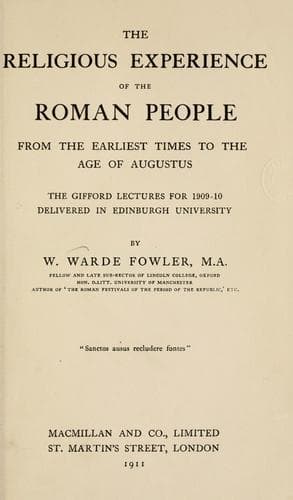
The Religious Experience of the Roman People: From the Earliest Times to the Age of AugustusFowler, W. Warde (William Warde)
Religion
The Religious Experience of the Roman People: From the Earliest Times to the Age of Augustus
Fowler, W. Warde (William Warde)
Cults -- Rome; Rome -- Religion
The passage is interesting as showing how natural it was
for a Roman of the Graeco-Roman period to suppose that
his deities must be capable of taking iconic form. For
anthropomorphic representations of Vesta in other places
and at Pompeii, see Wissowa, _Gesammelte Abhandlungen_,
p. 67 foll.
[290] See Lanciani, _Ruins and Excavations of Ancient
Rome_, p. 223 foll. The statues of the _virgines
vestales maximae_, discovered in the Atrium Vestae, all
belong to the period of the Empire. They are now in the
museum of the Baths of Diocletian.
LECTURE VII
THE DEITIES OF THE EARLIEST RELIGION: GENERAL CHARACTERISTICS
In the last lecture we interrogated the calendar as to the deities whose
festivals are recorded in it, with the aid of what we know of the most
ancient priesthoods attached to particular cults. The result may be
stated thus: we found a number of impersonal _numina_, with names of
adjectival form, such as Saturnus, Vertumnus, and so on; others with
substantival names, Tellus, Robigus, Terminus; the former apparently
functional deities, concerned in the operations of nature or man, and
the latter spirits immanent in objects--Mother Earth herself, a stone,
the mildew, or (like Janus and Vesta) the entrance and the hearth-fire
of human dwellings or cities. Lastly, we found from the evidence,
chiefly of the priesthoods, that certain more important divinities stand
out from the crowd of spirits, Janus, Jupiter, Mars, Quirinus, and
Vesta; and we found some reason to think that these, and possibly a few
of the others, by becoming the objects of priestly _cura_ and
_caerimonia_ at particular spots in the city, were not unlikely to
become also in some sense personal deities, to acquire a quasi-human
personality, if they came by the chance. In the present lecture I must
go rather more closely into such evidence as we possess bearing on the
mental conception which these early Romans had formed of the divine
beings whom they had admitted within their city.
Public-domain text, read in full here on John Shaqi.
Reviews
Reviews
No reviews yet
Be the first to share your thoughts on this work.
Elsewhere in the archive
Join the Discussion
Join the discussion
Sign in to leave a comment or review.
Sign InorCreate an account