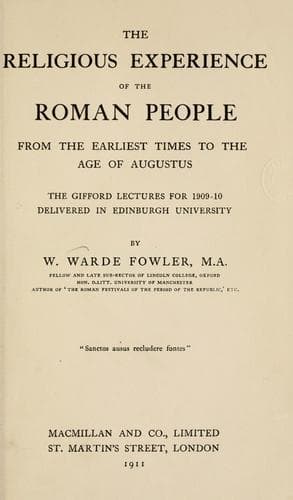
The Religious Experience of the Roman People: From the Earliest Times to the Age of AugustusFowler, W. Warde (William Warde)
Religion
The Religious Experience of the Roman People: From the Earliest Times to the Age of Augustus
Fowler, W. Warde (William Warde)
Cults -- Rome; Rome -- Religion
The real question is whether these passages from comic writers and an
annalist of no reputation combine to prove that there was an ancient
popular idea of Mars as a married god; as to the priestly view of the
matter they can, of course, prove nothing. It seems to me that Dr.
Frazer is entitled to argue that in the second century B.C. such a
popular idea existed,[308] which the Roman state religion did not
recognise, and which Aulus Gellius, as we have seen, could not agree
with. I do not, however, think him entitled to go farther, and to infer
that this was an idea of divinity native to Italy or of very old
standing. Is it not much simpler to suppose, with a cool-headed scholar
whom Dr. Frazer is willing to follow when it suits his turn, that pairs
or conjunctions of this kind, the true meaning of which I hope to
explain directly, were easily mistaken by the vulgar mind for married
god and goddess?[309] In those degenerate days of the Roman religion,
after the war with Hannibal, to which these writers belong--and all are
later than Ennius, the first to make mischief by ridiculing the
gods--nothing could be easier than to take advantage of what looked like
married life to invent comic passages to please a Roman audience, now
consisting largely of semi-educated men who had lost faith in their own
religion, and of a crowd of smaller people of mixed descent and
nationality. Such passages, in fact, cannot safely be used as evidence
of religious ideas, apart from the tendencies of the age in which they
were written. Had there really been religious beliefs, rooted in the old
Roman mind, about the wedded life of gods and goddesses, it would even
then have been dangerous to use them mockingly in comedy. And once more,
had there been such genuinely Roman ideas, why, in an age that made for
anthropomorphism, did they not find their way into the Roman
Pantheon,--why did they survive only in literary allusions, to the
bewilderment of scholars like Aulus Gellius?
Public-domain text, read in full here on John Shaqi.
Reviews
Reviews
No reviews yet
Be the first to share your thoughts on this work.
Elsewhere in the archive
Join the Discussion
Join the discussion
Sign in to leave a comment or review.
Sign InorCreate an account