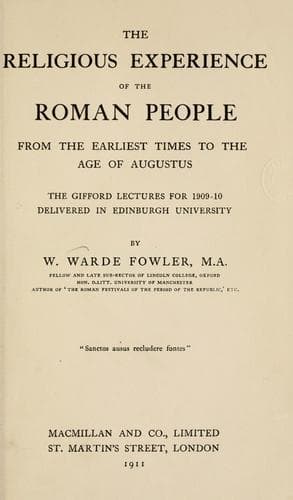
The Religious Experience of the Roman People: From the Earliest Times to the Age of AugustusFowler, W. Warde (William Warde)
Religion
The Religious Experience of the Roman People: From the Earliest Times to the Age of Augustus
Fowler, W. Warde (William Warde)
Cults -- Rome; Rome -- Religion
We know of them mainly, but not entirely, from Tertullian, and the _de
Civitate Dei_ of St. Augustine.[323] These scholarly theologians,
wishing to show up the absurdity of the heathen religions, found a mine
of material in the great work of Varro on the Roman religious
antiquities; and though they found him by no means so elegant a writer
as Cicero, they studied him with pains, and have incidentally added
immensely to our knowledge both of Varro himself and of the Roman
religion. St. Augustine tells us that it was in the last three books of
his work that Varro treated of the Roman deities, and that he divided
them under the heads of _di certi_, _di incerti_, and _di selecti_. In
the first of these he dealt chiefly with those with which we are now
concerned: they were _certi_ because their names expressed their
supposed activity quite clearly.[324] We know for certain that Varro
found these names in the books of the pontifices, and that they were
there called Indigitamenta:[325] a word which has been variously
interpreted, and has been the subject of much learned disputation. I
believe with Wissowa that it means "forms of invocation," _i.e._ the
correct names by which gods should be addressed.
Thus these lists of names come down to us at third hand: Varro took them
from the pontifical books, and the Christian fathers took them from
Varro. It is obvious that this being the case they need very careful
critical examination; and till recently they were accepted in full
without hesitation, and without reflection on such questions as, _e.g._,
whether they are psychologically probable, or whether they can be
paralleled from the religious experience of other peoples. Some
preliminary critical attempts were made about fifty years ago in this
direction,[326] but the first thoroughgoing examination of the subject
was published by R. Peter in the article "Indigitamenta" in Roscher's
_Mythological Lexicon_. This most industrious scholar, though his
interpretation of the word Indigitamenta is probably erroneous,[327] was
the first to reach the definite conclusion that the lists are not really
primitive, and do not, as we have them, represent primitive religious
thought. It was after a very careful study of this article, which is
long enough to fill a small volume, that I wrote in my _Roman Festivals_
of the Indigitamenta as "based on"--not actually representing, I might
have added--"old ideas of divine agency, now systematised by something
like scientific terminology and ordered classification by skilled legal
theologians"; and as "an artificial priestly exaggeration of a primitive
tendency to see a world of nameless spirits surrounding and influencing
all human life."[328]
Public-domain text, read in full here on John Shaqi.
Reviews
Reviews
No reviews yet
Be the first to share your thoughts on this work.
Elsewhere in the archive
Join the Discussion
Join the discussion
Sign in to leave a comment or review.
Sign InorCreate an account