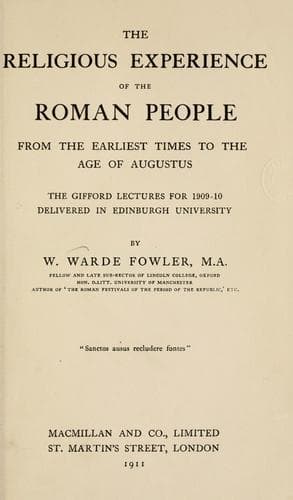
The Religious Experience of the Roman People: From the Earliest Times to the Age of AugustusFowler, W. Warde (William Warde)
Religion
The Religious Experience of the Roman People: From the Earliest Times to the Age of Augustus
Fowler, W. Warde (William Warde)
Cults -- Rome; Rome -- Religion
the limits which I have marked out." Then he said aloud what auspicia he
sought for (_i.e._ whether of birds, lightning, or what); and when they
appeared, Numa descended as rex from the citadel. This process was
called _inauguratio_; it is attested for the confirmation of the
election of the three flamines maiores, the rex, and the augurs, in
historical times,[355] whatever was the method of that election, and
without it the priest was not believed to be acceptable to the gods. It
is not mentioned by Roman writers in connection with the Pontifices or
the Vestals; if this be not merely from dearth of evidence, it is not
easy to account for, unless the reason were that neither body was
specially concerned with sacrifice. But the principle is perfectly
clear--that the person who is to represent the community in worship must
be one of whom the _numina_ openly express approval.
A priest, _sacerdos_, is thus a person set apart by special ritual for
the service of the _sacra populi Romani_. The rex no doubt himself made
the selection and supervised the inauguratio of the other priests at
whose head he was. When the kingship came to an end, his powers of this
kind passed to the pontifex maximus; and it may be as well to add at
once that his sacrificial powers, though they were in a special sense
inherited by a priest who took his title, the _rex sacrorum_, passed
with the civil power to all magistrates _cum imperio_, who wore the
_toga praetexta_ symbolic of priestly function, and had the right of
presiding at sacrificial rites both at home and in the field. Thus
magistrate and priest, though quite distinct under the Republic from the
point of view of public law, have certain characteristics in common as
deriving from a common source in the powers of the rex.[356]
But to return to the period of Numa and the calendar: it was not only
necessary that the priest should be acceptable to the gods, but that he
should be marked off from the rest of the community as being dedicated
to their service. As Dr. Jevons says,[357] in all early religions
priests are marked off from other worshippers, partly by what they do,
and partly by what they may not do; and what he means is (1) that the
priest originally was the person who alone could slay a victim; (2) that
in consequence of his sacredness he was subject to a great number of
restrictions. I have already spoken of these restrictions or priestly
taboos in my second lecture; and as I believe that in the period we are
now dealing with they were little more than a survival, I shall not
return to them now. But of the outward insignia, which marked off the
priest as alone entitled to perform the essential act of worship, the
sacrifice, and which bring him out of the region of the _profanum_ into
that of _sacrum_, I must say a few words before going farther.
Public-domain text, read in full here on John Shaqi.
Reviews
Reviews
No reviews yet
Be the first to share your thoughts on this work.
Elsewhere in the archive
Join the Discussion
Join the discussion
Sign in to leave a comment or review.
Sign InorCreate an account