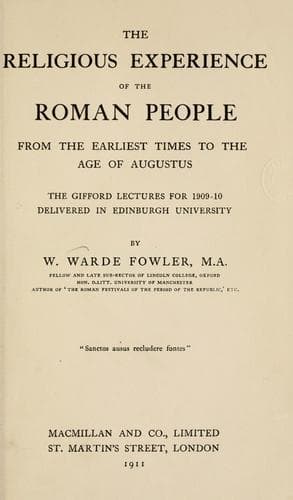
The Religious Experience of the Roman People: From the Earliest Times to the Age of AugustusFowler, W. Warde (William Warde)
Religion
The Religious Experience of the Roman People: From the Earliest Times to the Age of Augustus
Fowler, W. Warde (William Warde)
Cults -- Rome; Rome -- Religion
[364] They, of course, wore the _praetexta_ when
performing religious acts. Cp. the Fratres Arvales, who
laid aside the _praetexta_ after sacrificing. Henzen,
_Acta Fr. Arv._ pp. 11, 21, and 28.
[365] Serv. _Aen._ xi. 543. The _camillae_ assisted the
_flaminicae_, Marquardt, p. 227. This is one of the most
beautiful features of the stately Roman ritual, and has
been handed on to the Roman Church. It was, of course,
derived from the worship of the household (see above, p.
74).
[366] _Adonis, Attis, Osiris_, p. 413 foll. Dr. Frazer
is criticising Dr. Farnell, who had touched on the
subject in the _Hibbert Journal_ for 1907, p. 689, and
had taken the more obvious view that death in a family
disqualified for actions requiring extreme holiness.
[367] The passages are collected in Marquardt, p. 174
foll.; we may notice in particular Livy xlv. 5. 4,
where, though only the washing of hands is referred to,
we have the important statement that "omnis praefatio
sacrorum," _i.e._ the preliminary exhortation of the
priest, enjoined _purae manus_. Livy must be using the
language of Roman ritual, though he is not speaking here
of a Roman rite. For the material of sacred utensils see
Henzen, _Acta Fratr. Arv._ p. 30.
[368] Tibullus ii. 1. 11.
[369] Cic. _de Legibus_, ii. 10. 24.
[370] Westermarck, _Origin and Development of Moral
Ideas_, ii. 352 foll.; consult the index for further
allusions to the subject. Cp. Farnell, _Evolution of
Religion_, Lecture III. [Fehrle, _Die kultische
Keuschheit im Altertum_ (Giessen, 1910), has reached me
too late for use in this chapter.]
[371] Full details, with the most important references
quoted in full, are in Marquardt, p. 172 foll.; but some
of the latter are applicable only to the Graeco-Roman
period.
[372] So we may gather from the Lex Furfensis of 58 B.C.
(_C.I.L._ ix. 3513), and that of the Ara Augusti at
Narbo of A.D. 12 (_C.I.L._ xii. 4333).
[373] The real origin of the pontifices and their name
is unknown to us. If they took their name from the
bridging of the Tiber, as Varro held (_L.L._ v. 83) and
as the majority of scholars believe (see O. Gilbert,
_Rom. Topographie_, ii. 220, note), the difficulty
remains that they are found in such a city as Praeneste,
where there was no river to be bridged, and where they
could not well have been merely an offshoot from the
Roman college; see Wissowa, _R.K._ p. 432, note. Nor can
we explain how they came to be set in charge of the _ius
divinum_; and where there are no data conjecture is
useless.
Public-domain text, read in full here on John Shaqi.
Reviews
Reviews
No reviews yet
Be the first to share your thoughts on this work.
Elsewhere in the archive
Join the Discussion
Join the discussion
Sign in to leave a comment or review.
Sign InorCreate an account