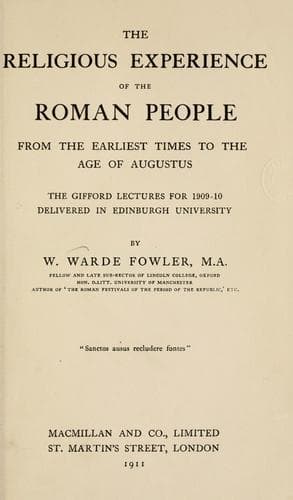
The Religious Experience of the Roman People: From the Earliest Times to the Age of AugustusFowler, W. Warde (William Warde)
Religion
The Religious Experience of the Roman People: From the Earliest Times to the Age of Augustus
Fowler, W. Warde (William Warde)
Cults -- Rome; Rome -- Religion
So important a part did these processional rites play in the public life
of the Roman people,--so characteristic are they too of the old Roman
habit of thought and action, that they have given a wonderful word to
the Latin language. _Lustrare_ has many meanings; but the one which is
immediately derived from the rites I speak of, that of slow processional
movement, is the most beautiful and impressive of them all. When Aeneas
first sees Dido in all her stately beauty, he says:[440]
in freta dum fluvii current, _dum montibus umbrae
lustrabunt convexa_, polus dum sidera pascet,
semper honos nomenque tuum laudesque manebunt,
quae me cunque vocant terrae.
"So long as the cloud-shadows move slowly over the hollows of the
hills." Here in Scotland you must have all seen this procession of the
shadows, as I have watched it when fishing in Wales; let us always
associate it with the magic of a poet of nature as well as with the
religious processions of his people.
_Lustrare_, _lustratio_, are words which, as I think, belong to an age
of religion, that is, according to our formula, of effective desire to
be in right relation with the Power manifesting itself in the Universe.
In other processes which are usually called purificatory, magic seems to
survive: the word _februum_, from which comes the name of our second
month, meant an object with magical potency, such as water, fire,
sulphur, laurel, wool, or the strips of the victims sacrificed at the
Lupercalia, and the verb _februare_ meant to get rid of certain
unwholesome or miasmatic influences by means of these objects.[441] What
was the really primitive idea attached to these words need not concern
us now; but Varro, and Ovid following him, explicitly explain them as
meaning _purifying_ agents and processes,[442] from which we may infer
that they had a magical power to produce certain desired conditions, or
to protect from evil influences, like charms and amulets. But _lustrare_
and _lustratio_ seem to belong to an age when the thing to be driven or
kept away is rather spiritual mischief, and when the means used are
sacrifices and prayers, with processional movement.
Public-domain text, read in full here on John Shaqi.
Reviews
Reviews
No reviews yet
Be the first to share your thoughts on this work.
Elsewhere in the archive
Join the Discussion
Join the discussion
Sign in to leave a comment or review.
Sign InorCreate an account