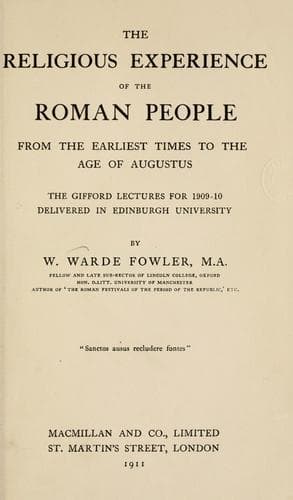
The Religious Experience of the Roman People: From the Earliest Times to the Age of AugustusFowler, W. Warde (William Warde)
Religion
The Religious Experience of the Roman People: From the Earliest Times to the Age of Augustus
Fowler, W. Warde (William Warde)
Cults -- Rome; Rome -- Religion
A last word before I leave this part of my subject. Though it is
interesting to try to get at the root-idea of these processes of
_lustratio_, we must remember that in the Rome of history they had lost
not only such magical meaning as they ever had, but also much of the
religious meaning which in course of time was superimposed upon it. The
sacrifices and the prayers remained, but the latter were muttered and
unheard by the people. And except in the country districts these
ceremonies were more and more absorbed, as time went on, into the
social, military, and political life of the community, as _e.g._ the
lustration of the host became a political census; or they tended to
disappear altogether, like the _ambarvalia_ and perhaps the _amburbium_.
They grew up in the religious experience of the Romans, beginning with
its very earliest and quasi-magical forms; but they came at last to
represent that experience no longer, and when we meet with them in
historical times it is impossible to ascribe to them any real influence
on life and conduct. _Lustratio_ never in pagan Italy developed an
ethical meaning as _catharsis_ did in Greece.[462] But meaningless as
they were, the stately processions remained, and could be watched with
pride by the patriotic Roman all through the period of the Empire, until
the Roman Church adapted them to its own ritual and gave them, as we
saw, a new meaning. As the cloud-shadows still move slowly over the
hollows of the Apennines, so does the procession of the patron saint
pass still through the streets of many an Italian city.[463]
NOTES TO LECTURE IX
[406] Dill, _Roman Society in the Last Century of the
Western Empire_, p. 63.
[407] See Westermarck, _Origin and Development of Moral
Ideas_, ii. 615 foll.
[408] _C.I.L._ i. Nos. 43 foll.
[409] _C.I.L._ xiv. 2863. See _R.F._ p. 224, and
Wissowa, _R.K._ p. 209.
[410] _Op. cit._ vol. i. p. 252; cp. 271.
[411] See Sir Alfred Lyall's _Asiatic Studies_, Series
I. ch. vi. No one would call the vow of Aeneas, in
_Aen._ vi. 69, a bargain with Apollo and the Sibyl.
[412] Marquardt, p. 266; Mommsen, _Staatsrecht_, i.^2
594 foll. The ceremony is best described by Ovid, _Ex
Ponto_, iv. 9. 5 foll. He is addressing the consul of
the year from his place of exile:
at cum Tarpeias esses deductus in arces,
dum caderet iussu victima sacra tuo,
me quoque secreto grates sibi magnus agentem
audisset media qui sedet aede deus.
(II. 28 foll.)
[413] Valerius Maximus iv. 1. 10.
[414] A list of these is given in Aust, _De aedibus
sacris populi Romani_ (Marpurg, 1889). A valuable work,
which will be of service to us later on.
[415] Livy xxxvi. 2. 3.
[416] _Ib._ xxii. 10.
Public-domain text, read in full here on John Shaqi.
Reviews
Reviews
No reviews yet
Be the first to share your thoughts on this work.
Elsewhere in the archive
Join the Discussion
Join the discussion
Sign in to leave a comment or review.
Sign InorCreate an account