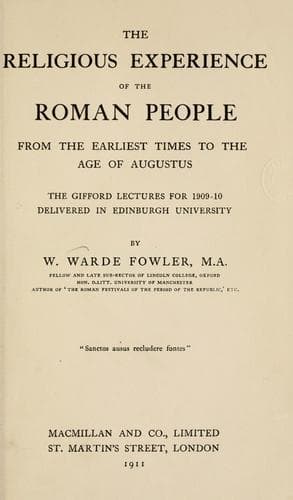
The Religious Experience of the Roman People: From the Earliest Times to the Age of AugustusFowler, W. Warde (William Warde)
Religion
The Religious Experience of the Roman People: From the Earliest Times to the Age of Augustus
Fowler, W. Warde (William Warde)
Cults -- Rome; Rome -- Religion
gain which you had vowed at the outset of an enterprise.[477]
In the same period, though the traditional date of their temple is
later, came the Twin Brethren, Castor and Pollux, and found their way,
like Hercules, into the city within the _pomoerium_. The famous temple
of Castor (before whom his brother gradually gave way) was at the end
of the Forum under the Palatine, close to the fountain of Juturna, where
the Twins watered their horses after the battle of Lake Regillus; and
there the beautiful remains of the latest reconstruction of it still
stand.[478] This position alone should make us feel confident that the
cult did not come direct from Greek sources; and it had its origin,
perhaps, in the period when Rome was in close relation with Latin
cities, which themselves had been gradually absorbing the cults and
products of the Greeks of Campania. There is a strong probability that
it came from Tusculum, with which the legend of the Regillus battle is
closely connected, and where the cult had beyond doubt taken strong
root.[479] Like the Hercules of the _ara maxima_, the Twins were no
doubt brought by the course of trade, which was continually pushing up
from the south; for they too were favourites of the merchant adventurer,
and throughout Hellas were the special protectors of the seafarer. Their
connection with horses is well known, and not as yet satisfactorily
explained in its Roman aspect; but Dr. J. B. Carter thinks that they
first became prominent in Greece when the Homeric use of chariots was
abandoned for a primitive kind of cavalry, and that "the Castor-cult
moved steadily northward (from Magna Graecia), carried, as it were, on
horseback," and that when it reached Rome it became connected with the
reorganisation of the cavalry. This seems to be almost pure guess-work,
and, attractive as it is, I fear we cannot put much faith in it.[480]
The position in the Forum, and the well-known connection of both twins
with oaths,[481] seem to me rather to suggest a more natural origin in
trade. I would suggest that the equine character of the cult in Latium
was secondary, and that the connection of the temple and cult with the
Roman cavalry was a natural result, but not a primary feature, of its
introduction. I should be inclined to look on it as coming in with the
building of the temple, which was probably of later origin than the
original introduction of the cult.
Public-domain text, read in full here on John Shaqi.
Reviews
Reviews
No reviews yet
Be the first to share your thoughts on this work.
Elsewhere in the archive
Join the Discussion
Join the discussion
Sign in to leave a comment or review.
Sign InorCreate an account