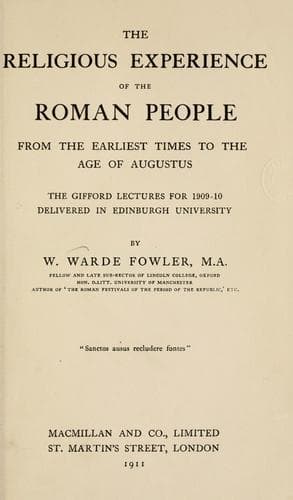
The Religious Experience of the Roman People: From the Earliest Times to the Age of AugustusFowler, W. Warde (William Warde)
Religion
The Religious Experience of the Roman People: From the Earliest Times to the Age of Augustus
Fowler, W. Warde (William Warde)
Cults -- Rome; Rome -- Religion
[474] Wissowa, _R.K._ p. 219 foll.; Carter, _Religion of
Numa_, p. 31 foll. The ground had been prepared for the
new view by the elaborate articles in Roscher's
_Mythological Lexicon_, vol. ii. pp. 2253 foll. and 2901
foll. Of late a painstaking discussion by J. G. Winter
has appeared in the _University of Michigan Studies for
1910_, p. 171 foll.; he mainly confirms Wissowa's
conclusions, but provisionally accepts a suggestion of
mine (_R.F._ 197) that the tithe practice of the _ara
maxima_ may possibly have been of Phoenician origin, and
points out that E. Curtius made the same suggestion as
long ago as 1845. On p. 269 he also dwells, very
properly, I think, on the part which the Etruscans may
have had in the dissemination of the myth and cult of
the Greek Heracles. Wissowa, however, stoutly maintains
that these are simply Greek and of commercial origin. It
has been Wissowa's special and valuable function to
elucidate the Greek origin of many Roman cults and
legends; but I doubt if he has adequately considered the
influence of other peoples, and in particular of
Phoenicians and Etruscans. Certainly the Hercules
question is not finally settled by his masterly analysis
of it in _R.K._ p. 220 foll. But most of what I said in
_R.F._ about the Hercules of the _ara maxima_ may now be
considered obsolete; and I may add that my remarks on
the supposed connection of Hercules with Genius, Dius
Fidius, and Jupiter in the same work, p. 143 foll., have
lost much strength since Wissowa's book appeared. Yet I
am not prepared to accept the view which would deny to
Hercules on Italian soil all contamination with Italian
ideas; as Willamowitz-Moellendorf puts it (_Herakles_,
ed. 2, vol. i. p. 25), "Die Italiker haben dem Koerper,
den sie uebernahmen, den Odem ihrer eigenen Seele
eingeblasen: aber wie der Name ist der Gestalt des
Hercules hellenischer Import." There are points in
connection with the Roman Hercules, _e.g._ the _nodus
herculaneus_ of the bride's girdle, which Wissowa does
not explain, and which, so far as I can see, can only be
explained by assuming that, as might have been expected,
the Greek Hercules became to some extent entangled in
the web of Italian thought.
Public-domain text, read in full here on John Shaqi.
Reviews
Reviews
No reviews yet
Be the first to share your thoughts on this work.
Elsewhere in the archive
Join the Discussion
Join the discussion
Sign in to leave a comment or review.
Sign InorCreate an account