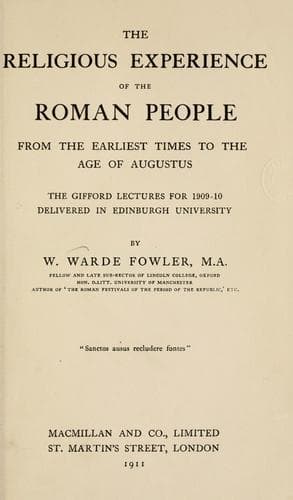
The Religious Experience of the Roman People: From the Earliest Times to the Age of AugustusFowler, W. Warde (William Warde)
Religion
The Religious Experience of the Roman People: From the Earliest Times to the Age of Augustus
Fowler, W. Warde (William Warde)
Cults -- Rome; Rome -- Religion
We shall shortly hear so much of petrifaction and disintegration, that
it may be as well, before I actually begin my story, to convince
ourselves that the old religion was in its peculiar way a real
expression of religious feeling, and not merely a set of meaningless
conventions and formulae. It was the positive belief of the later Romans
that both they and their ancestors were _religiosissimi mortales_,[510]
full to the brim, that is, of religious instinct, and most scrupulous in
fulfilling its claims upon them; for the word _religio_ had come, by the
time (and probably long before the time) when it was used by men of
letters, to mean the fulfilment of ritualistic obligation quite as much
as the anxious feeling which had originally suggested it.[511] Cicero,
writing in no rhetorical mood, declared that, as compared with other
peoples, the Romans were far superior "in religione, id est cultu."[512]
This is in his work on the nature of the gods; in an oration he
naturally puts it more strongly: "We have overcome all the nations of
the world, because we have realised that the world is directed and
governed by the will of the gods."[513] Sallust, Livy, and other Roman
prose writers have said much the same thing[514]; the _Aeneid_ as a
whole might be adduced as evidence, and in a less degree all the poets
of the Augustan age. Foreigners, too, were struck with the strange
phenomenon, in an age of philosophic doubt. Polybius in the second
century B.C. declared his opinion that what was reckoned among other
peoples as a thing to be blamed, _deisidaimonia_, both in public and
private life, was really what was holding together the Roman state.[515]
Even in the wild century that followed, Posidonius could repeat the
assertion of Polybius, and in the age of Augustus, Dionysius of
Halicarnassus, then resident at Rome, looking back on the early history
of Rome, stated his conviction that one needed to know the _pietas_ of
the Romans in order to understand their wonderful career of
conquest.[516] Aulus Gellius, in a curious passage in which he notes
that the Romans had no deity to whose activity they could with
certainty ascribe earthquakes, describes them as "in constituendis
religionibus atque in dis immortalibus animadvertendis _castissimi
cautissimique_,"--a rhetorical but happy conjunction of epithets. He
means that they would order religious rites, though ignorant of the
_numen_ to whom they were due.[517]
It might be argued that these later writers knew really little or
nothing about the primitive Romans, and that these passages only prove
that this people had an extraordinary scrupulosity about forms and
ceremonies in this as in other departments of action. But the argument
will not hold; the survival of all this formalism into an age of
disintegration really proves beyond a doubt that there must have been a
time when these forms really expressed anxieties, fears, convictions,
the earliest germs of _conscience_.
Public-domain text, read in full here on John Shaqi.
Reviews
Reviews
No reviews yet
Be the first to share your thoughts on this work.
Elsewhere in the archive
Join the Discussion
Join the discussion
Sign in to leave a comment or review.
Sign InorCreate an account