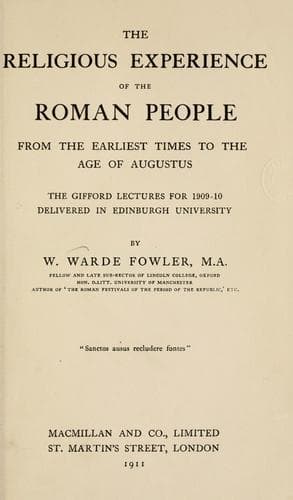
The Religious Experience of the Roman People: From the Earliest Times to the Age of AugustusFowler, W. Warde (William Warde)
Religion
The Religious Experience of the Roman People: From the Earliest Times to the Age of Augustus
Fowler, W. Warde (William Warde)
Cults -- Rome; Rome -- Religion
Gratitude was not a prominent characteristic of the Roman, but I
have already remarked on the presence of it in the practice of the
_votum_, and there is at least some evidence that it was recognised as
due to benignant deities as well as human beings.[525]
In public life, throughout Roman history, the forms of religious rites
were maintained on all important occasions. When Varro wrote a little
manual of Senatorial procedure for the benefit of the inexperienced
Pompeius when consul in 70 B.C., he was careful to mention the
preliminary sacrifice and _auspicatio_, performed by the presiding
magistrate, who also had to see that the business _de rebus divinis_
came first on the paper of agenda.[526] At one time every speaker
invoked the gods at the beginning of his oration, as well indeed he
might in a situation so unusual and trying for a Roman before the days
of Greek education; and the earliest speeches preserved in the literary
age, _e.g._ those of Cato and the Gracchi, retained the religious
exordium.[527] We have a trace of the Gracchan practice in a famous
passage at the end of the work called _Rhetorica ad Herennium_ of
_circ._ 82 B.C., where the death of Ti. Gracchus is graphically
described.[528] But there is no need to multiply examples of public
religious formalism on occasions of all kinds, on entering on an office,
founding a colony, leaving Rome for a provincia, and so on; some of them
I have already mentioned, others are familiar to all classical students.
So let us not hesitate for a moment to give this people credit for their
religiousness. True, their neighbours, Greeks like Polybius, approved of
it only with an ironical smile on their lips, as we may smile at the
devoted formalism of extreme Catholic or Protestant, while we
secretly--if we have some sympathy with strangely varying human
nature--admire the confidence and regularity that we cannot ourselves
claim. At the moment where I have thus paused before beginning my second
story, at the end, that is, of the regal period, I believe that this
religious system, though perhaps beginning to harden, still meant a
profound belief in the Power thus manifested in many forms, and an
ardent and effective desire to be in right relation to it. I believe
that it contained the germ of a living and fruitful growth; but that
growth was at this very moment arrested by the beginning of a process of
which I shall have much to say in the next two or three lectures.
Public-domain text, read in full here on John Shaqi.
Reviews
Reviews
No reviews yet
Be the first to share your thoughts on this work.
Elsewhere in the archive
Join the Discussion
Join the discussion
Sign in to leave a comment or review.
Sign InorCreate an account