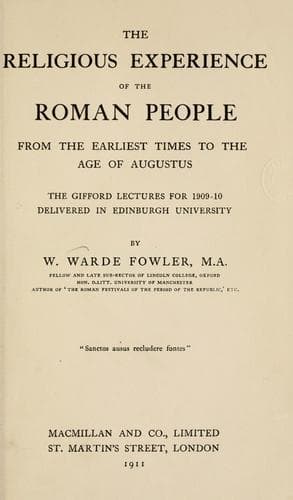
The Religious Experience of the Roman People: From the Earliest Times to the Age of AugustusFowler, W. Warde (William Warde)
Religion
The Religious Experience of the Roman People: From the Earliest Times to the Age of Augustus
Fowler, W. Warde (William Warde)
Cults -- Rome; Rome -- Religion
But what _was_ this Sibylline influence which thus penetrated to Rome,
if I am right, at the beginning of the fifth century? It is no part of
my design to discuss the history of Greek mysticism, though we shall
hear something more of it in a later lecture. It will be enough to
remind you that in the sixth century Greece was not only full of Orphism
and Pythagoreanism, but of floating oracular _dicta_ believed to emanate
from a mystic female figure, a weird figure of whom it is hard to say
how far she was human or divine; and of whose origin we know nothing,
except that her original home was, as we might expect, Asia Minor. She
was inspired by Apollo,[538] it was said, like the Pythia, and like her
too became [Greek: entheos] (_possessed_) when uttering her prophecies;
this is the earliest fact we know about her, for a famous fragment of
Heracleitus represents her as uttering sayings "with frenzied
lips,"[539]--a tradition of which Virgil has made good use in the sixth
_Aeneid_:
non vultus, non color unus,
non comptae mansere comae; sed pectus anhelum,
et rabie fera corda tument.
But more to our purpose is the sober judgment of Plato a century after
the first Roman experience of her, who in the _Phaedrus_ classes her
among those who have wrought _much good_ by their inspired
utterances.[540] This passage may help us to understand how ready men
were at that time to turn for aid in tribulation to what they believed
to be divine help, to an inspired wisdom beyond the range of the local
deities of their own city-states.
This Sibyl became gradually localised in certain Greek cities, and
thereby broke up, as it were, into several Sibyls. One of these
Sibylline homes was at Cumae in Campania, the oldest Greek city in
Italy, and this enables us to explain easily how the name and fame of
the Sibyl reached Rome. Dim as is all early Roman history, the one clear
fact of the sixth century is, as we have seen, the rapid advance of the
Etruscans, their occupation of Rome, Praeneste, and other Latin cities,
and their conquest of Campania, which is now ascribed to that same
age.[541] Legend told in later days how the last Etruscan king had taken
refuge at Cumae after his expulsion from Rome, and it is just possible
that it may here be founding upon some dim recollection of a fact.
However this may be, it is plain that it was through the great Etruscan
disturbance of that period that Rome came to make trial of Sibylline
utterances. In a moment of distress--the famine of which I spoke just
now, and which I take to be historical because the remedy, the temple
under the Aventine, was so closely connected with the corn-supply--she
sent for or admitted an utterance of the Sibyl of Cumae, with whom she
had come into some kind of contact through her Etruscan kings.
Public-domain text, read in full here on John Shaqi.
Reviews
Reviews
No reviews yet
Be the first to share your thoughts on this work.
Elsewhere in the archive
Join the Discussion
Join the discussion
Sign in to leave a comment or review.
Sign InorCreate an account