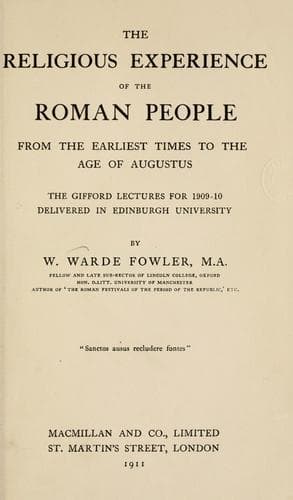
The Religious Experience of the Roman People: From the Earliest Times to the Age of AugustusFowler, W. Warde (William Warde)
Religion
The Religious Experience of the Roman People: From the Earliest Times to the Age of Augustus
Fowler, W. Warde (William Warde)
Cults -- Rome; Rome -- Religion
I have so far assumed that this college existed in the age of the kings,
and assisted the Rex in the administration of the _ius divinum_. It is
legitimate to do this, but as a matter of fact we do not know for
certain what was the origin of the college itself, or of its mysterious
name. In the period we have now reached we come, however, upon a
striking fact, which is luckily easy to interpret; the king's house, the
_Regia_, has become the office of the head of the college, the pontifex
maximus, and also the meeting-place of the college for business.[557]
Obviously this head, whether or no he existed during the kingly period,
has stepped into the place of the Rex in the control of the _ius
divinum_. Again, we know that in the third century B.C., when written
history begins, the pontifices and their head had reached a very high
level of power, as we shall presently see more in detail; the process of
the growth of this power must therefore lie in the two preceding
centuries, during which Rome was slowly attaining that paramount
position in Italy in which we find her at the time of the Punic wars.
Thirdly, we know that in that third century B.C. the college was laid
open to plebeians as well as to members of the old patrician gentes, and
that one of the most famous of all its many distinguished heads was not
only not a patrician, but a Latin from Cameria, Ti. Coruncanius. Putting
these three facts together we can divine in outline the history of the
pontifices during these two centuries. With the instinct for order and
organisation that never failed them, the Romans have constructed a
_permanent_ power to take charge of their _ius divinum_, _i.e._ all
their relations to the deities with whom they must maintain a _pax_; the
circumstances of their career during two centuries have exalted this
power to an extraordinary degree of influence, direct and indirect,
internal and external; and, lastly, in a period which saw the gradual
amalgamation into a unified whole of privileged and unprivileged,
_patres_ and _plebs_, they have with wonderful wisdom thrown open to all
citizens the administration of that _ius_ which was essential to the
welfare of the united community. These are indisputable facts; and they
are thoroughly characteristic of the practical wisdom of the Roman
people in that early age.
In order to understand how the pontifices attained their great position,
the one thing needful is to examine the nature of their work. This I
propose to do next, and then to attempt to sum up the result of their
activity on the Roman religious system.
Public-domain text, read in full here on John Shaqi.
Reviews
Reviews
No reviews yet
Be the first to share your thoughts on this work.
Elsewhere in the archive
Join the Discussion
Join the discussion
Sign in to leave a comment or review.
Sign InorCreate an account